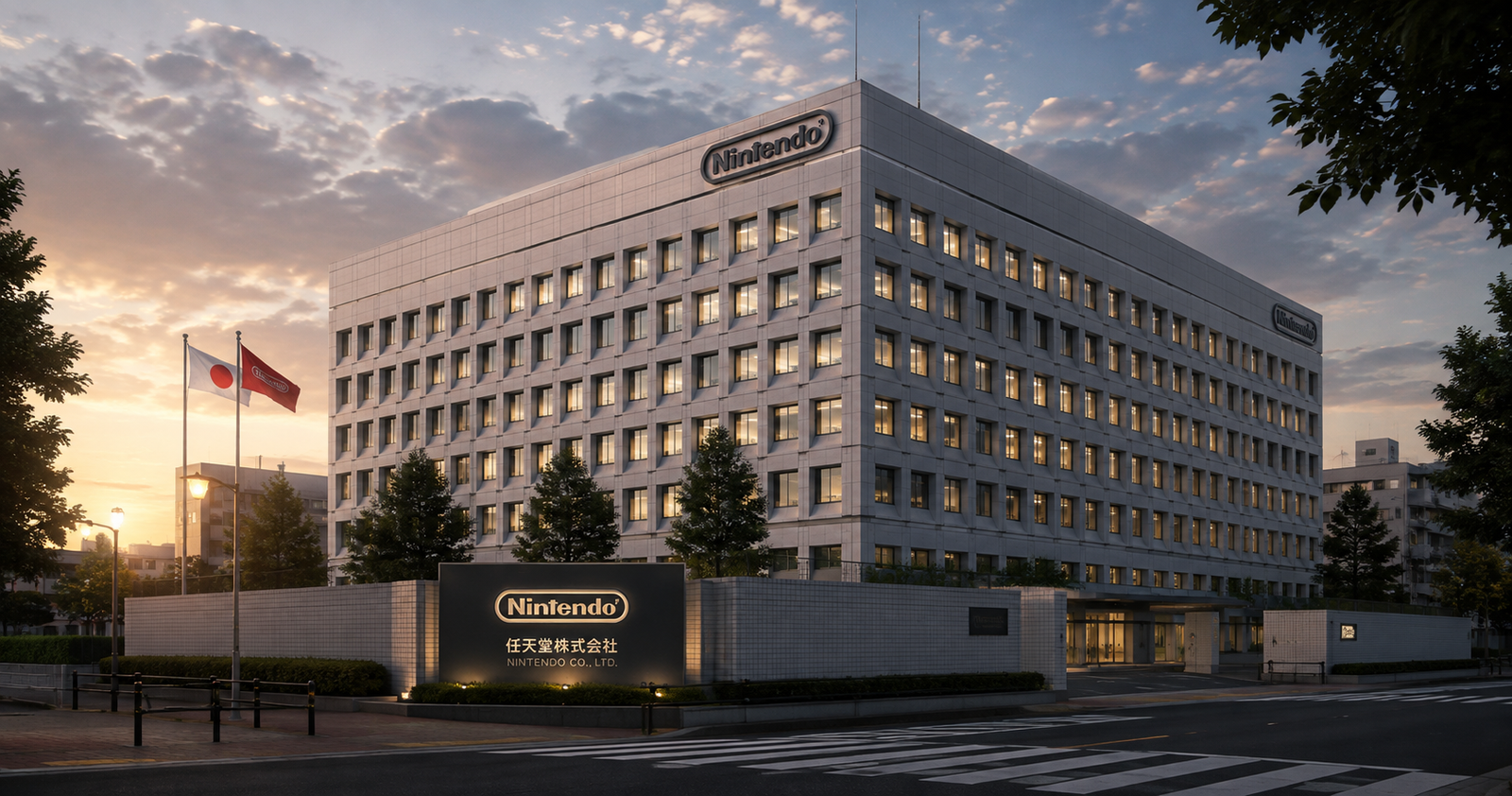
01 — AT A GLANCE
From Hanafuda cards to one of gaming's most influential companies
Nintendo's history stretches back far beyond video games. Founded in Kyoto in 1889 by Fusajiro Yamauchi, the company began by manufacturing and selling Hanafuda playing cards before gradually experimenting with new forms of entertainment.
More than a century later, Nintendo had become one of the most recognizable names in interactive entertainment. Its transformation was not built around a single product or a single generation of hardware. The company repeatedly moved into new forms of entertainment, learning from successes and failures along the way.
Nintendo's journey passed through playing cards, toys, electronic products, arcade machines, home consoles and handheld systems before the company became closely associated with franchises such as Mario, The Legend of Zelda, Donkey Kong, Pokémon, Kirby, Animal Crossing, Metroid, Pikmin and Splatoon.
That history makes Nintendo unusual in the gaming industry. Few companies have survived and reinvented themselves across so many different eras of entertainment while maintaining such a strong connection between their hardware, software and characters.
02 — THE BEGINNING
How Nintendo started in Kyoto
Nintendo was founded in 1889 by Fusajiro Yamauchi in Kyoto, Japan. At the time, the company had nothing to do with electronic entertainment or video games. Its business centered on the production of Hanafuda playing cards, a traditional Japanese card format.
The early company operated in a very different entertainment market from the one Nintendo would eventually dominate. Physical games were the product, manufacturing quality mattered, and the company's relationship with consumers was built around an object that could be held, collected and played with.
The business eventually expanded its playing-card operations and explored opportunities beyond its original product. That willingness to experiment would become one of the defining characteristics of Nintendo's history.
Nintendo's origins are important because they show that the company was never created specifically to become a video-game manufacturer. Its identity developed gradually through more than a century of experimentation.
03 — EXPANSION
Nintendo moved beyond playing cards
During the twentieth century, Nintendo began exploring businesses outside traditional playing cards. The company experimented with different entertainment products and eventually moved toward toys and games that could reach a wider audience.
This period was important because Nintendo was learning how to compete in entertainment rather than simply in card manufacturing. The company developed products that depended on physical interaction, simple rules and accessible experiences.
Nintendo's experiments included toys and other forms of entertainment, and some of these products demonstrated an increasingly important idea: technology could make traditional play more interactive.
That transition eventually brought Nintendo closer to the emerging electronic entertainment industry. The company did not immediately become a console manufacturer, but its experiments created a path toward the video-game business.
04 — ELECTRONIC ENTERTAINMENT
Nintendo discovered the potential of electronic games
Nintendo's move toward electronic entertainment changed the direction of the company and created the foundation for its future as a video-game giant.
As electronic games became increasingly popular, Nintendo began working with new technologies and entertainment formats. The company explored products that brought electronic interaction into the home and helped establish Nintendo's presence in an emerging industry.
One of the important figures during this transformation was engineer Gunpei Yokoi, whose work contributed to several of Nintendo's early electronic entertainment products. His approach often emphasized making technology affordable, understandable and fun rather than simply making it technically impressive.
This philosophy would later become visible across Nintendo's hardware. The company repeatedly looked for ways to turn unfamiliar technology into something approachable for ordinary players.
Nintendo's early electronic experiments also prepared the company for a much larger opportunity: the rapidly developing video-game market.
05 — ARCADE ERA
Donkey Kong put Nintendo on the global map
Nintendo's emergence as a major video-game company was closely connected to the arcade industry. In the early 1980s, the company released Donkey Kong, a game that became one of the most important early successes in Nintendo's history.
The game introduced players to a character who would later become known as Mario while combining platforming, timing and simple but increasingly challenging level design.
Donkey Kong demonstrated that Nintendo could create characters and gameplay concepts that were immediately understandable while still being memorable enough to build a lasting audience around.
The success of the arcade game also helped establish Nintendo's ability to create recognizable characters rather than treating games as disposable pieces of entertainment.
That character-driven approach would become one of Nintendo's greatest competitive advantages in the decades that followed.
06 — NES
The Nintendo Entertainment System changed the home console market
Nintendo's next major transformation came with the Family Computer, known as the Famicom in Japan, which launched in 1983. The system was designed to bring arcade-style entertainment into the home through dedicated hardware and interchangeable game cartridges.
Nintendo later introduced the system internationally as the Nintendo Entertainment System, or NES. Its success helped Nintendo become one of the dominant names in home video games.
The NES was supported by games that would become foundational parts of Nintendo's identity, including Super Mario Bros., The Legend of Zelda and other major franchises.
Nintendo also developed a tightly controlled approach to software publishing. Quality-control systems and licensing policies helped the company maintain consistency across its game library while creating a more structured relationship between Nintendo and outside developers.
The NES era established a formula Nintendo would repeatedly revisit: distinctive hardware, recognizable characters and software designed specifically around the strengths of the platform.
07 — HANDHELD GAMING
Game Boy turned Nintendo into a handheld powerhouse
Nintendo's influence was not limited to living-room consoles. In 1989, the company released the Game Boy, a handheld system that helped make portable gaming a major part of the industry.
The Game Boy was not the most technically powerful handheld of its generation. Nintendo instead focused on accessibility, battery life, durability and a strong library of games.
That strategy proved extremely effective. The system became closely associated with games such as Tetris, Super Mario Land and later the Pokémon series.
Game Boy demonstrated something that would repeatedly appear in Nintendo's hardware strategy: technical specifications were only one part of the equation. A system could succeed because the overall experience was convenient, understandable and supported by compelling software.
The success of Game Boy also gave Nintendo an enormous advantage in handheld gaming that lasted for decades.
08 — NINTENDO 64
Nintendo entered the 3D era
The transition from two-dimensional games to three-dimensional worlds created one of the biggest technological changes in gaming history. Nintendo responded with the Nintendo 64, released in 1996.
The system's most important software included Super Mario 64, which demonstrated how a familiar character could be transformed into a fully three-dimensional environment.
Instead of simply translating traditional platforming into a new visual format, Nintendo designed gameplay around movement through three-dimensional space. Camera control, exploration and freedom of movement became central parts of the experience.
The Nintendo 64 also helped establish Nintendo's continued interest in multiplayer experiences. Four controller ports made local multiplayer a defining part of several games on the platform.
The generation showed that Nintendo could adapt its most recognizable franchises to major technological changes without abandoning the simple gameplay principles that made them accessible.
09 — A NEW AUDIENCE
From GameCube to Wii, Nintendo changed who gaming was for
Nintendo's GameCube era was followed by one of the company's most important strategic shifts. Instead of competing purely on technical specifications, Nintendo began focusing more aggressively on accessibility and new audiences.
The Nintendo DS expanded the company's handheld strategy with two screens and touch controls. Its design encouraged developers to experiment with interfaces that were very different from traditional game controllers.
The Nintendo Wii pushed that philosophy even further. Its motion-sensitive controller allowed players to interact with games through physical movement, making the system easier to demonstrate and understand for people who had little previous experience with video games.
Games such as Wii Sports became cultural phenomena because they could be understood almost immediately. Players did not need to know complex controller combinations before they could begin interacting with the game.
The strategy helped Nintendo reach audiences beyond traditional console players and demonstrated that gaming hardware could succeed by changing the definition of who a gamer was.
10 — THE WII U LESSON
The Wii U showed the risks of confusing innovation with clarity
Nintendo's next home console, the Wii U, attempted to build on the company's experimentation with new forms of interaction. Its central feature was a controller with a built-in touchscreen that could provide additional information and gameplay options.
The concept offered interesting possibilities, but the system struggled to communicate its identity clearly to consumers. Many people were unsure whether the Wii U was a completely new console or an accessory for the existing Wii.
The platform also faced challenges from a changing market and competition from other consoles and devices.
The Wii U ultimately became one of Nintendo's weaker-selling major home consoles, but its ideas were not simply discarded.
Several concepts introduced during the Wii U generation helped inform Nintendo's next major hardware strategy. The company had learned that innovative hardware needed to be understandable as well as technically interesting.
11 — NINTENDO SWITCH
Nintendo combined its handheld and home-console identities
The Nintendo Switch became one of the most important turning points in the company's modern history because it combined ideas that Nintendo had previously treated as separate.
Released in 2017, the Switch was designed to work as both a home console and a portable gaming system. Players could use it with a television and then continue playing in handheld mode.
That flexibility addressed a problem Nintendo had faced for years: maintaining separate home-console and handheld hardware strategies required different development resources and fragmented the company's software ecosystem.
The Switch brought Nintendo's major software franchises onto one primary platform. Games such as The Legend of Zelda: Breath of the Wild, Super Mario Odyssey, Animal Crossing: New Horizons and Mario Kart 8 Deluxe helped create a large and diverse library.
The system's detachable Joy-Con controllers also continued Nintendo's tradition of experimenting with how players interact with games.
The Switch ultimately demonstrated that Nintendo did not need to compete directly with other companies on raw hardware power to create a successful platform. Its strongest advantage was the combination of portability, accessibility and Nintendo's software library.
12 — THE FRANCHISES
Why Nintendo's characters became more valuable than individual consoles
Nintendo's long-term strength comes from more than hardware. Its characters and game worlds have become some of the most recognizable properties in entertainment.
Mario evolved from an arcade character into the central figure of one of gaming's most successful platforming franchises. The Legend of Zelda developed into a series built around exploration, adventure and puzzle solving. Pokémon became a global multimedia phenomenon spanning games, trading cards, animation and merchandise.
Other franchises expanded Nintendo's identity in different directions. Metroid became associated with exploration and atmospheric science fiction. Kirby offered accessible platforming. Animal Crossing focused on social simulation and everyday life. Splatoon introduced a new competitive identity built around colorful team-based gameplay.
The important part is that Nintendo's franchises are not interchangeable. Each has its own gameplay identity, visual language and audience.
This portfolio allows Nintendo to appeal to different types of players while maintaining a consistent connection between its characters, software and hardware.
13 — DESIGN PHILOSOPHY
Nintendo's real advantage is designing around play
Nintendo's hardware history can look unpredictable from the outside. The company moved from cartridges to discs, from traditional controllers to motion controls, from dual screens to touch interfaces and eventually to a hybrid console.
But there is a consistent idea underneath those changes: Nintendo tends to design technology around a specific type of play.
The company often begins with a gameplay idea and then asks what hardware could make that idea easier, more interesting or more accessible.
This is different from simply adding new technology because it is available. Nintendo's most successful hardware innovations have generally been connected to something players could immediately understand.
That philosophy explains why Nintendo can sometimes appear conservative in one generation and unusually experimental in another. The company is not necessarily trying to follow the fastest technological trend. It is trying to find a useful relationship between hardware and play.
The approach has produced both major successes and failures, but it has also helped Nintendo maintain a distinctive identity in an industry where hardware and software can otherwise become increasingly similar.
14 — SWITCH 2
Nintendo entered its next hardware generation
Nintendo's next major hardware chapter followed the enormous success of the original Switch. The company's challenge was not simply to create a more powerful machine, but to preserve the basic idea that made the Switch distinctive.
Nintendo Switch 2 continues the hybrid concept while introducing a newer hardware platform designed to support more demanding games and improved visual experiences.
The importance of this transition goes beyond specifications. Nintendo had spent the Switch generation building a unified software ecosystem around a single hybrid platform, so its next system needed to continue that strategy while giving developers more technical capability.
The transition also represents a test of Nintendo's ability to maintain momentum between hardware generations. The original Switch became one of the company's defining successes, creating a large installed audience and an unusually broad software library.
The next generation therefore carries a simple but difficult responsibility: evolve the platform without losing the accessibility and flexibility that made the original concept successful.
15 — THE BIGGER IMPACT
Why Nintendo's influence reaches far beyond video games
Nintendo's impact on gaming cannot be measured only by console sales or individual game releases. The company's larger contribution is the way it has repeatedly changed how people interact with games.
Nintendo helped establish recognizable video-game characters as cultural icons. Mario became one of the most recognizable characters in entertainment. The Legend of Zelda helped define exploration-based adventure games. Pokémon demonstrated how a game franchise could become part of a much larger multimedia ecosystem.
Nintendo also influenced hardware design. The company's handheld systems helped normalize portable gaming, while the Wii demonstrated the potential of motion-controlled interaction and the Switch showed that a single device could bridge the traditional divide between home and portable gaming.
Its influence is also visible in game design. Nintendo's strongest games often prioritize readable controls, clear feedback, experimentation and mechanics that can be understood without extensive explanation.
That philosophy has allowed Nintendo's games to appeal to experienced players while remaining accessible to newcomers.
Perhaps the most important part of Nintendo's legacy is its willingness to experiment. Some experiments became major successes. Others failed. But the company repeatedly used those experiences to influence what came next.
Nintendo therefore represents something unusual in the history of gaming: a company that survived multiple technological transitions without allowing its identity to disappear inside them.
16 — WHERE NINTENDO STANDS TODAY
From a Kyoto card maker to a global entertainment company
Nintendo began in 1889 as a small Kyoto playing-card business. Its modern identity emerged only after decades of experimentation across toys, electronics, arcade games, handheld systems and home consoles.
The company eventually built an ecosystem where hardware and software reinforce one another. Its consoles provide the platform, while its first-party franchises give players a reason to choose that platform.
That relationship remains central to Nintendo's strategy. The company's most valuable assets are not only its hardware technologies but also the characters, worlds and gameplay systems that players associate with Nintendo.
From Hanafuda cards to Game Boy, from the NES to the Wii, from the Nintendo DS to the Switch and now into the next generation, Nintendo's history has been defined by reinvention.
The company has never followed a completely straight path. It has experienced extraordinary successes, difficult transitions and major strategic mistakes. What separates Nintendo from many of its competitors is its ability to turn those different eras into a continuous history rather than allowing each generation to completely replace the one before it.
17 — FINAL THOUGHT
Why Nintendo still matters
Nintendo's story is ultimately not just the story of a video-game company. It is the story of an entertainment business that repeatedly reinvented itself whenever the industry around it changed.
The company started with physical playing cards and eventually became one of the most influential creators of interactive entertainment in the world.
Its greatest strength has never been simply having the newest technology. Nintendo's advantage has been its ability to turn technology into approachable experiences and then build memorable games and characters around those experiences.
That philosophy has produced some of the most recognizable franchises and hardware in gaming history.
Nintendo's future will inevitably bring new hardware, new games and new experiments. But if its history is any indication, the most interesting part may not be the technology itself.
It will be what Nintendo decides to do with it.