01 — AT A GLANCE
From a small game studio to a force that reshaped PC gaming
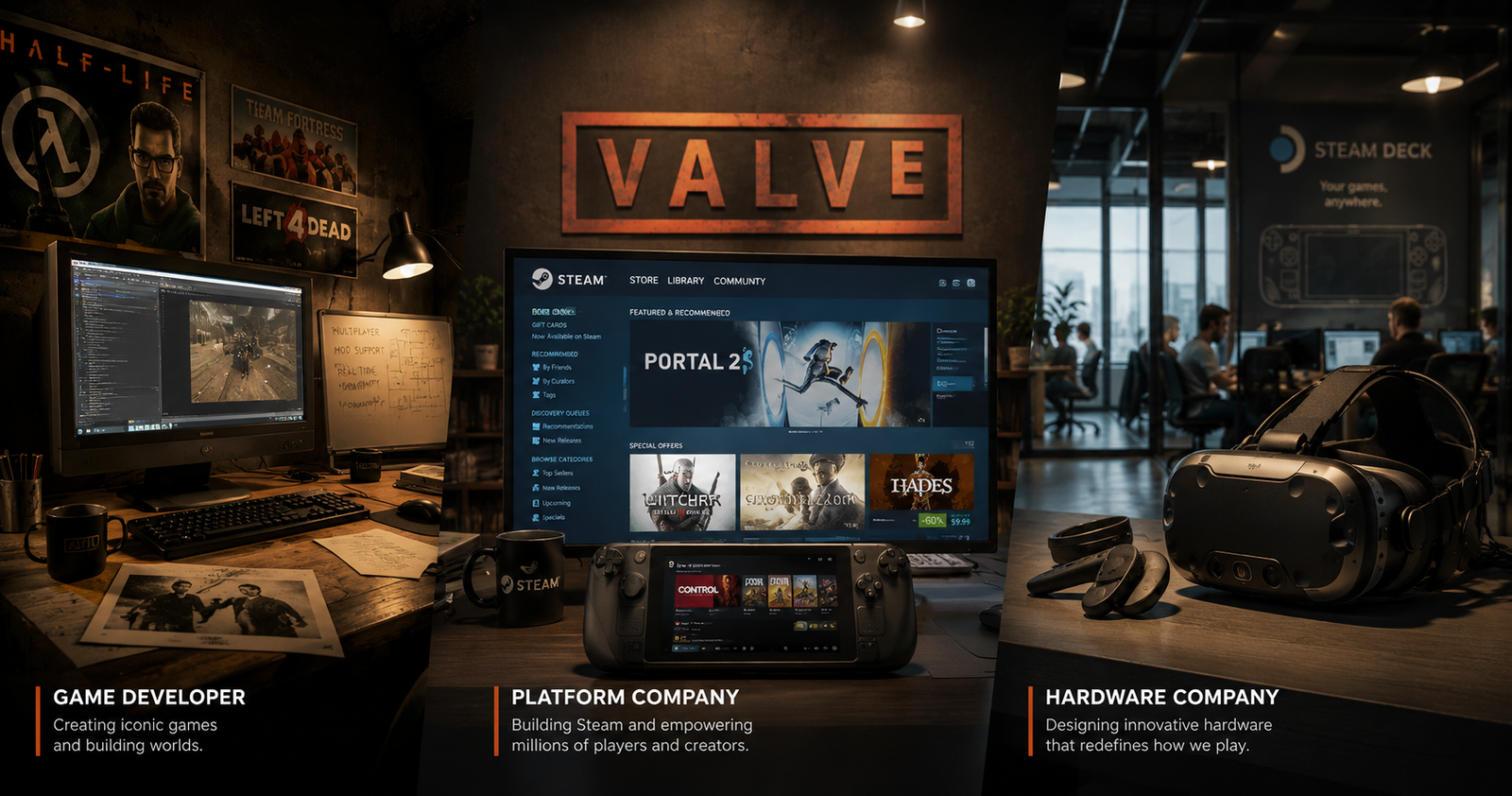
Valve began in 1996 as a game development company founded by Gabe Newell and Mike Harrington. Its debut game, Half-Life, established the studio as an important creative force, but Valve's influence would eventually extend far beyond individual games.
Over the years, Valve built a portfolio that included Half-Life, Counter-Strike, Team Fortress, Left 4 Dead, Portal and Dota. At the same time, the company developed technologies and platforms that changed how PC games were created, distributed and played.
The biggest example is Steam. What began as a system for distributing updates eventually became one of the defining platforms of modern PC gaming. Valve later expanded its work into virtual reality and hardware, including Steam Deck.
02 — THE BEGINNING
How Valve started
Valve was founded in 1996 by Gabe Newell and Mike Harrington, both of whom had previously worked at Microsoft. Rather than building another conventional software company, the founders wanted to create games that could push PC gaming forward.
The company's first major project began with technology licensed from id Software. Valve used the Quake engine as a starting point while developing the game that would eventually become Half-Life.
The early project did not immediately become the game players would eventually know. Valve's internal review concluded that the original version was not good enough to ship, forcing the team to rethink the project and rebuild major parts of the experience.
That decision became an important part of Valve's early identity. Instead of rushing a project to market, the company was willing to rebuild its work when the result did not meet its ambitions.
03 — HALF-LIFE
Half-Life changed what a first-person shooter could be
When Half-Life arrived in 1998, first-person shooters were already an established PC genre. Valve's approach was different.
Instead of treating the game as a sequence of disconnected shooting arenas, Valve built a continuous experience around Gordon Freeman, the Black Mesa research facility and a science-fiction disaster that gradually unfolded around the player.
The game placed greater emphasis on environmental storytelling, scripted sequences and a world that felt connected. The player was rarely removed from the experience simply to watch a conventional cinematic.
Half-Life became Valve's breakthrough and helped establish the company as one of the most influential PC game developers of its era.
04 — HALF-LIFE 2
Half-Life 2 pushed Valve's technology even further
Valve followed the original Half-Life with an even more ambitious project. Half-Life 2 combined a detailed world with a new technology foundation designed to support physics, character animation and interactive environments.
One of the game's defining ideas was that objects in the environment could become part of the gameplay. Physics was no longer simply something happening in the background; it could affect how players solved problems and interacted with the world.
The technology behind Valve's games also became increasingly important to the company. Its Source engine eventually became a foundation for several different games and helped Valve experiment with new forms of gameplay and multiplayer experiences.
05 — COUNTER-STRIKE
Counter-Strike turned competitive PC gaming into a phenomenon
Valve's influence was not limited to traditional single-player games. Counter-Strike became one of the company's most important multiplayer properties and helped establish competitive tactical shooters as a major part of PC gaming.
The game's focus was fundamentally different from the cinematic structure of Half-Life. Teams competed against each other in objective-based rounds where communication, positioning, accuracy and strategy mattered as much as individual reflexes.
Over time, Counter-Strike became one of the most recognizable competitive games in the world. Its continued evolution eventually led to Counter-Strike 2, which Valve lists among its current games.
06 — STEAM
Why Valve created Steam
Valve's most consequential project was not another game. It was Steam.
Steam was released in September 2003. In its early form, the platform was primarily used to make it easier for Valve to distribute updates to its games.
That seemingly practical idea eventually became much bigger.
Steam created a system where games could be connected to a user's account instead of being tied entirely to physical discs. Updates could be delivered digitally, online services could be integrated into the platform, and developers gained a direct relationship with players.
What began as a distribution and update system gradually became the foundation for a much broader PC gaming ecosystem.
08 — NEW FRANCHISES
Portal, Left 4 Dead and the expansion of Valve's ideas
Valve continued experimenting with different forms of gameplay instead of relying on a single formula.
Portal transformed a simple physics concept into a puzzle game built around spatial reasoning and experimentation. Its distinctive portal mechanic gave players a completely different way to think about movement and level design.
Left 4 Dead took another approach. It focused on cooperative multiplayer, placing four players together against constantly changing waves of enemies. The result was an experience designed around communication and teamwork rather than traditional competitive play.
These games demonstrated Valve's ability to move between genres while maintaining a strong focus on systems that encouraged players to experiment.
09 — DOTA
Dota helped define another generation of online gaming
Valve's relationship with the Dota series further expanded its role in online gaming.
Dota 2 became one of the company's most important competitive games and helped establish a massive ecosystem around team-based strategy, live updates and esports.
The game's development also demonstrated how Valve could operate a long-running online title rather than treating every game as a traditional one-time release.
That model became increasingly important to Valve's overall business. Its games, platform technology and online services could reinforce one another instead of existing as completely separate products.
10 — DEVELOPMENT CULTURE
Why Valve became known for doing things differently
Valve developed a reputation for an unusual approach to game development. The company has historically given its teams significant freedom and has been willing to spend years developing projects rather than following a predictable annual release schedule.
That approach has produced some of the company's most influential games, but it also creates a very different rhythm from the traditional game-publishing model.
Valve's history is therefore defined as much by the projects it released as by the projects and ideas that never reached players.
The result is a company with a relatively selective release history but an unusually large influence on the games that did make it to the public.
11 — HARDWARE
Valve returned to hardware
Valve eventually expanded beyond software and digital distribution into hardware.
The company introduced Steam Hardware products in 2015 and later expanded its work into virtual reality with SteamVR.
The most significant modern example is Steam Deck.
Steam Deck takes the idea of a PC gaming library and puts it into a handheld form. Instead of building a closed console ecosystem around a separate software catalog, Valve designed the device around Steam and PC gaming.
The hardware combines traditional gamepad controls with PC-style features such as trackpads and access to a desktop environment. Valve designed the device around the flexibility of PC gaming while making the experience more approachable in handheld form.
12 — STEAM DECK
Steam Deck showed what Valve's larger strategy had become
Steam Deck connects several parts of Valve's history in one product.
The games come from Valve's software heritage. The library comes from Steam. The operating system and hardware bring the company's platform philosophy into a physical device.
In that sense, Steam Deck is not simply another gaming handheld. It represents Valve's attempt to make the PC gaming ecosystem more portable without abandoning the flexibility that defines PC gaming.
Valve's Steam Deck lineup has also evolved since the original launch, with newer hardware iterations improving the display, battery efficiency and overall handheld experience.
13 — THE BIGGER IMPACT
Valve changed more than the games it made
Valve's influence on gaming is difficult to measure through individual game sales alone.
Half-Life influenced first-person storytelling. Counter-Strike helped shape competitive multiplayer. Portal demonstrated how a simple mechanic could become the foundation of an entire puzzle game. Dota 2 became a major force in competitive gaming.
But Steam may ultimately be Valve's most important contribution.
By creating a persistent digital platform for buying, updating, discovering and playing PC games, Valve helped move PC gaming away from a world dominated by physical releases toward an ecosystem built around digital libraries and connected services.
That shift affected not only players but developers and publishers as well. Independent studios gained another route to reach audiences, while players gained access to a constantly expanding digital library.
14 — WHERE VALVE STANDS TODAY
From game developer to gaming ecosystem
Today, Valve operates across games, Steam and hardware.
That description captures how dramatically the company has evolved since 1996.
Valve began by trying to make a great PC game. It then built technologies around those games, created Steam to distribute and update them, expanded into online gaming and eventually developed hardware designed to bring the Steam ecosystem beyond the traditional desktop.
Its portfolio includes long-running franchises such as Counter-Strike and Dota alongside the Half-Life, Portal and Team Fortress series. Valve has also continued experimenting with new technology and hardware rather than limiting itself to a single part of the gaming industry.
The company's story is therefore not simply the history of a game studio. It is the story of how a developer gradually became part of the infrastructure of PC gaming itself.
15 — FINAL THOUGHT
Why Valve still matters
Valve's history is unusual because its biggest impact came from several different directions at once.
The company created influential games, developed technology for those games, built a digital distribution platform and eventually created hardware around that same ecosystem.
Few gaming companies have played such different roles in the evolution of PC gaming.
Whether the next chapter comes through new games, Steam, hardware or technologies that have not yet been announced, Valve's influence on PC gaming is already difficult to separate from the history of the platform itself.