
The Sound of Gaming: Why Music and Audio Matter So Much
From footsteps and environmental sounds to adaptive music and voice acting, audio does far more than accompany a game. It tells players where they are, what is happening and how they should feel.

Game audio is easy to underestimate because it often disappears into the experience.
When it works, players rarely stop to think about it. They simply hear rain and accept that the world is wet. They hear footsteps approaching and instinctively become alert. A musical change can make an ordinary room suddenly feel dangerous.
That is part of what makes game audio different from simply putting a soundtrack underneath a video. Audio has to react to a world that the player is controlling.
The modern game-audio discipline covers much more than music. It includes sound effects, environmental ambience, dialogue, implementation, mixing, spatial audio, programming and the technical systems that connect all of those pieces to gameplay. GDC's audio program treats these areas as interconnected parts of contemporary game development.
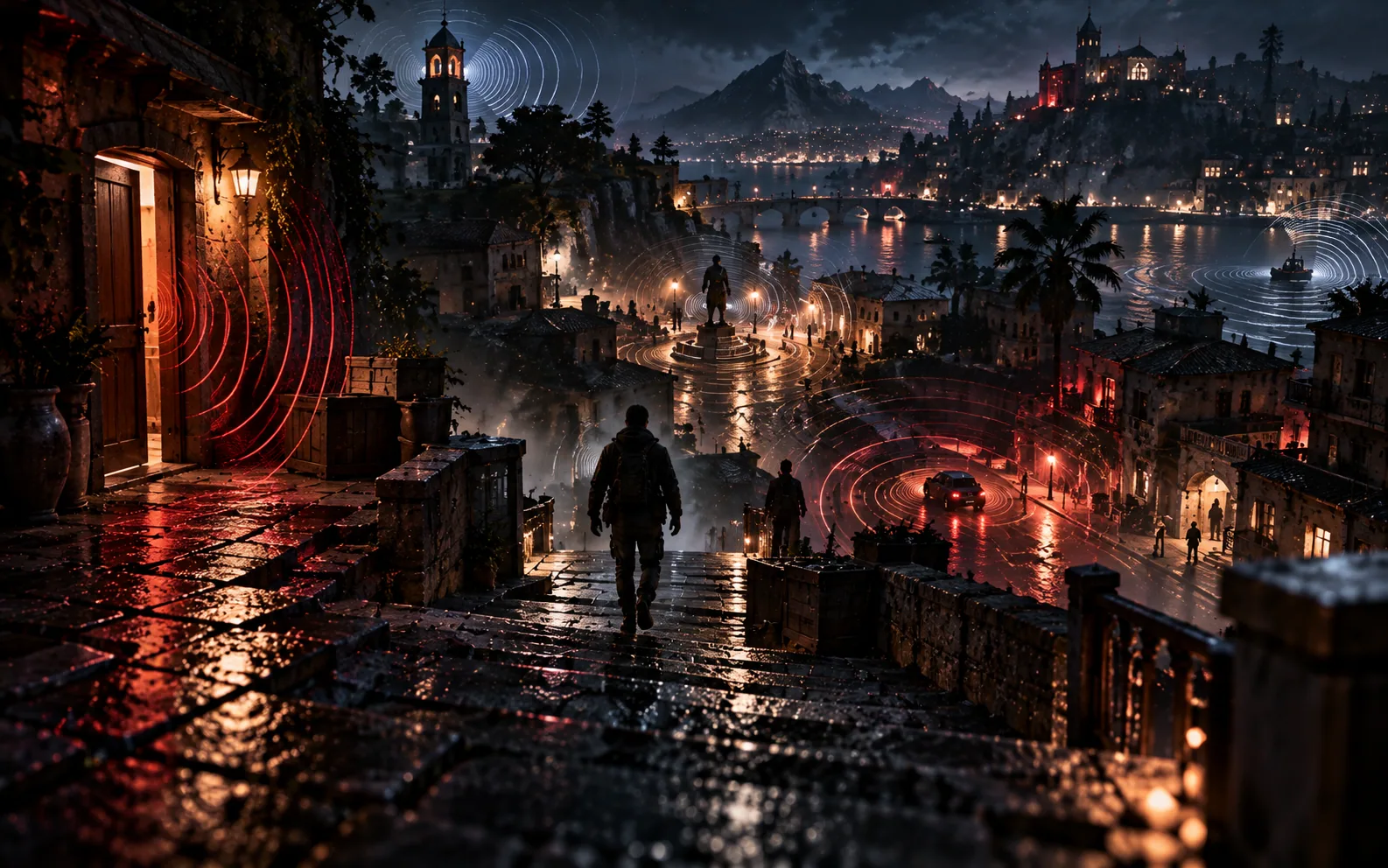
Think about walking through a fictional city.
The buildings establish the visual setting, but the soundscape gives the city its rhythm. Traffic moves somewhere beyond the player. People talk in the distance. Machinery hums. Wind moves through narrow streets. A door closes inside a building the player cannot see.
None of these sounds necessarily needs to become the focus of attention.
Their job is to make the environment feel occupied.
This is one reason environmental audio can be so important in open-world and exploration-heavy games. The player is constantly moving between spaces, and each space needs its own sonic identity.

A character walking across stone should not necessarily sound the same as that character walking across wood, mud or metal.
Modern engines can connect audio behavior to the material underneath a character. Unreal Engine's MetaSounds learning material, for example, describes a footstep system where physical materials determine which corresponding sound preset is triggered.
That principle can extend far beyond footsteps.
A weapon can sound different indoors and outdoors. A vehicle can react acoustically to its environment. A sound can become muffled when something blocks its path. A large room can produce a different reverberation from a small enclosed space.
The player may never see the system behind these decisions.
They simply hear a world that behaves consistently.

A player might spend thirty seconds exploring an area, suddenly enter combat, escape from an enemy, stop to search a room and then return to exploration.
A fixed soundtrack cannot perfectly predict any of that.
Interactive music systems solve the problem differently.
Instead of treating a song as one uninterrupted recording, developers can divide music into segments, layers and states that respond to gameplay.
Audiokinetic's Wwise documentation describes interactive music structures using playlists, music segments, switches, states and transitions. FMOD similarly provides systems specifically designed for adaptive music and sound.

Interactive music can respond to intensity, location, combat state or other gameplay conditions.
Wwise's own learning material describes systems where game state and intensity can control musical behavior, including switching between ambient and action music and dynamically changing layers.
A particularly useful modern example comes from Clair Obscur: Expedition 33.
The Unreal Engine team describes how the game's audio system used different music contexts for exploration, battle, cinematics, menus and dialogue. Its music manager could transition between these contexts while MetaSounds handled the individual tracks and their transitions.
That means the soundtrack is not simply a playlist.
It is part of the game's logic.
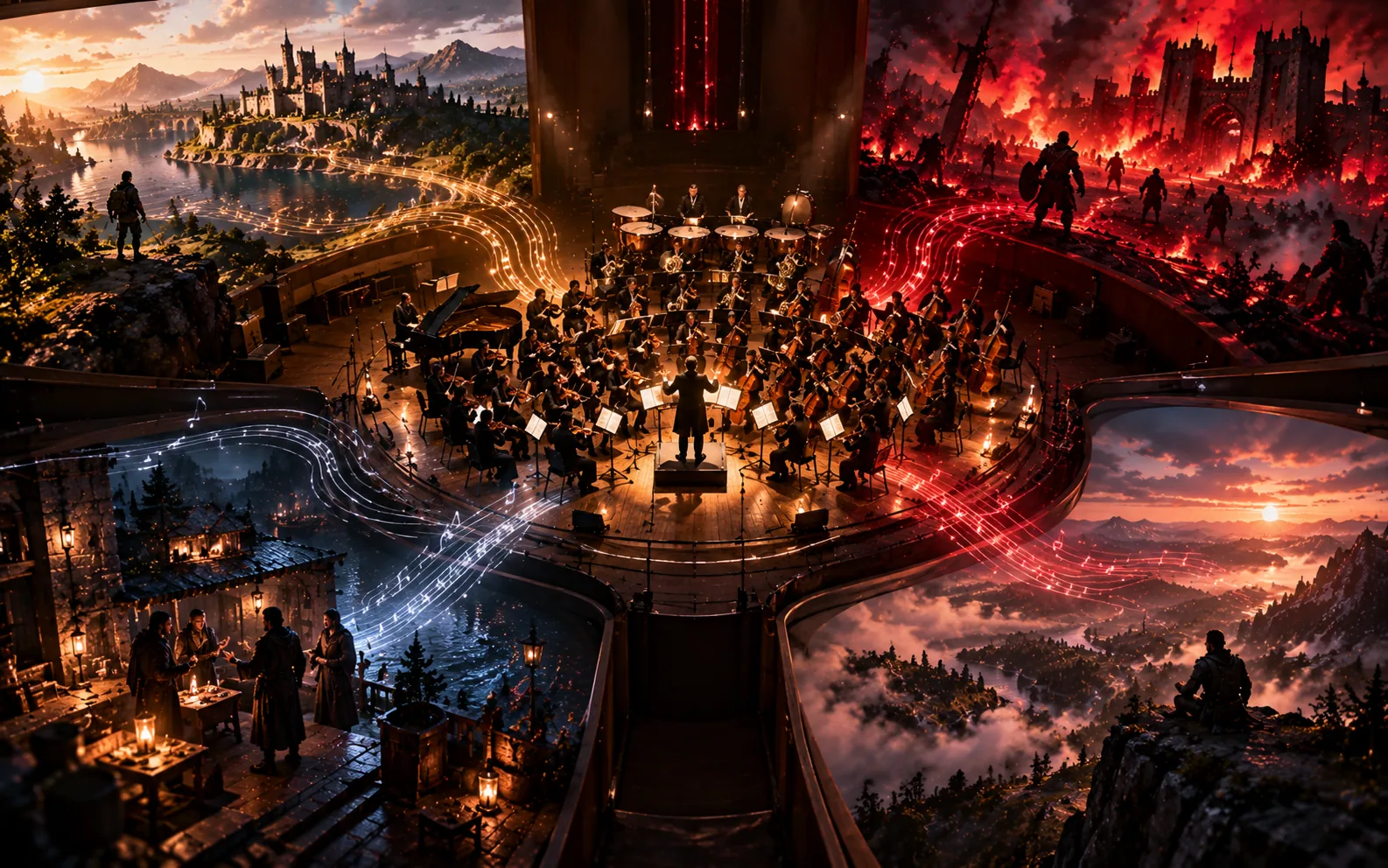
Constant audio can make a game feel busy.
Silence creates contrast.
A horror game can use the absence of music to make a player listen more carefully. An action sequence can become more intense when a loud environment suddenly drops into near silence. A quiet room can make the next sound feel enormous.
This is one reason audio design is also about restraint.
The goal is not to fill every second with sound.
It is to decide which sounds deserve the player's attention.

Dialogue is another major part of game audio.
But recording dialogue for an interactive game is different from recording a conventional film performance. Lines may need to work in different gameplay states, repeat under different circumstances, support localization and integrate with systems that control when dialogue plays.
GDC's current audio programming and performance material reflects how closely dialogue, performance, narrative and technical implementation overlap in modern game production.
Voice is therefore not just a recording that gets dropped into a game.
It has to survive interaction.
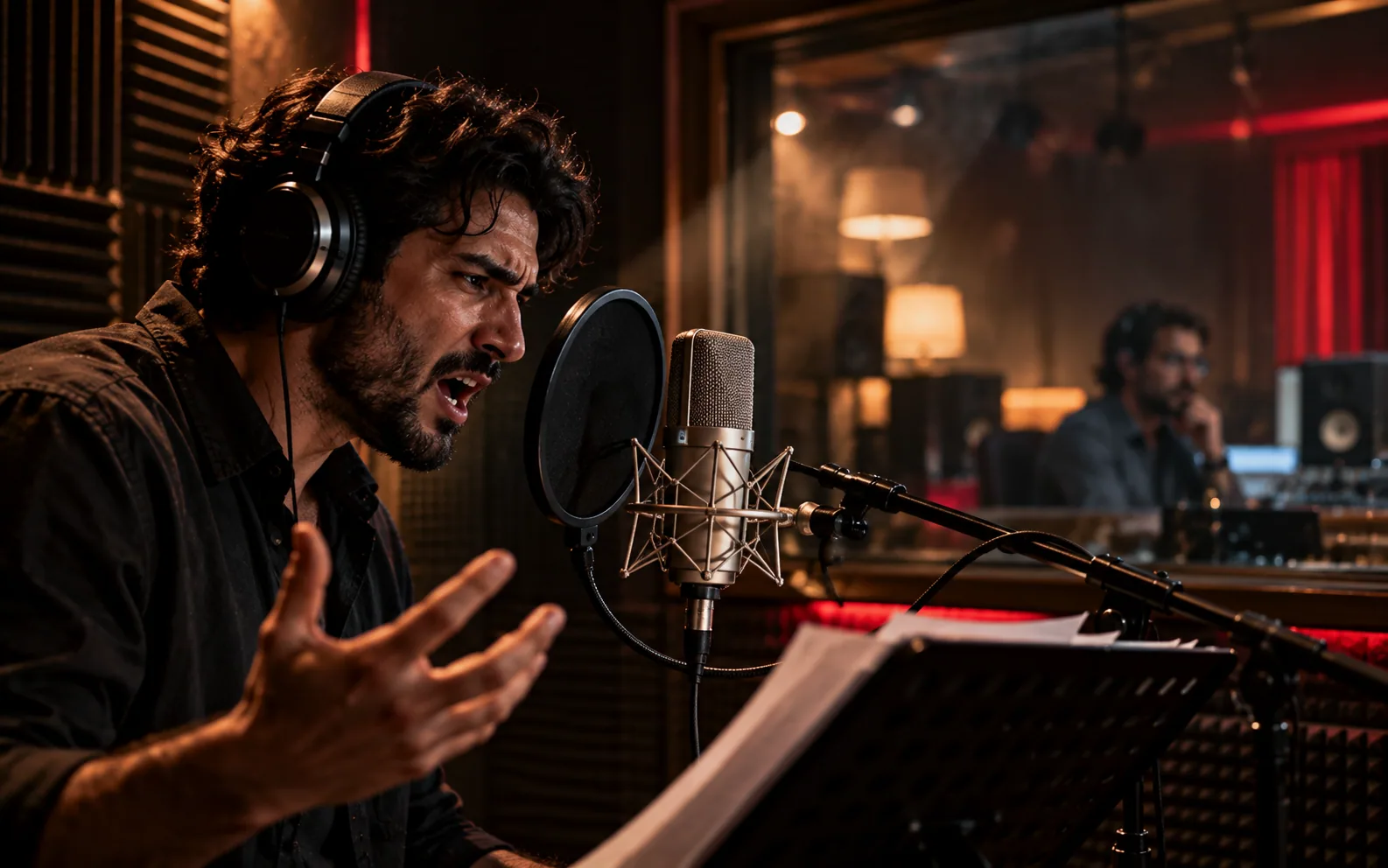
Sound designers can record real-world objects and environments to build libraries of source material.
A physical object might be struck, scraped, dropped, stretched or manipulated to produce a sound that can later be edited into something completely different.
GDC's 2026 audio program includes dedicated discussion of field and Foley recording, emphasizing how original recordings can provide varied and distinctive source material for game sound design.
The interesting part is that the final sound does not have to resemble the recording literally.
A collection of ordinary recordings can become the sound of a fictional creature, a futuristic machine or an impossible weapon.

Spatial audio can make a sound feel positioned within a three-dimensional environment rather than simply placed somewhere on a left-right stereo spectrum.
The underlying systems can become extremely sophisticated.
Audiokinetic's material on spatial audio discusses rooms and portals, reverb zones, geometry, diffraction, transmission loss and reflections.
The 2026 GDC session on Battlefield 6 provides a current example of this kind of work. EA DICE's presentation covers acoustic systems including early and late reflections, occlusion and obstruction, developed for a game where destruction is a core part of the experience.
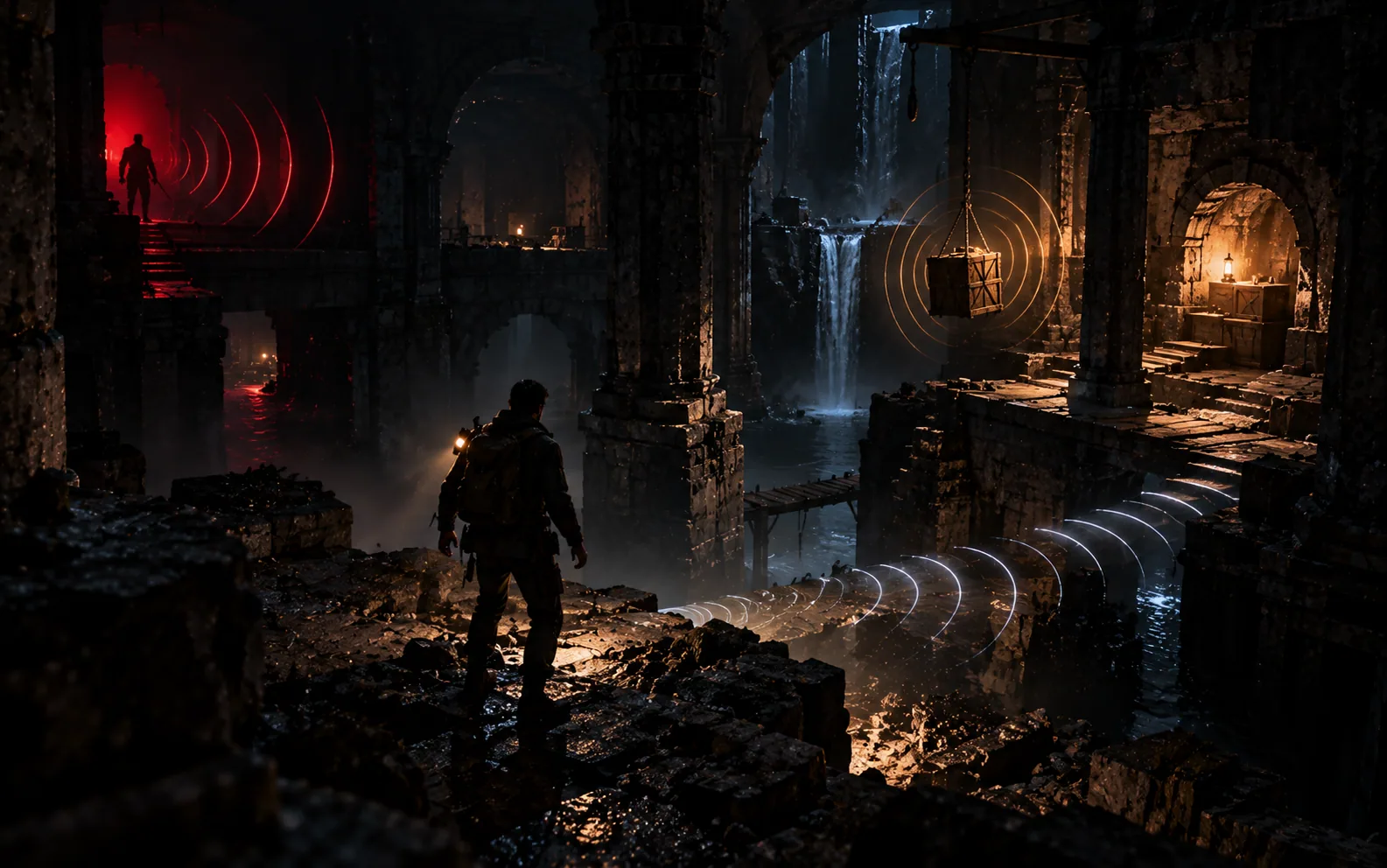
That matters because sound can provide information the player cannot see.
Something happening behind a wall can still be heard.

Players constantly use sound as feedback.
A menu click confirms an interaction.
A weapon sound tells the player that something happened.
A warning sound can signal danger before the player has visually identified its source.
And accessibility can make this function even more important.
The Last of Us Part II includes traversal and combat audio cues designed to communicate gameplay information through sound. Naughty Dog documented cues for things such as climbable gaps, nearby interactions, incoming attacks and successful hits, alongside broader accessibility features.
This demonstrates something important:
Audio is not always decoration.
Sometimes it is information.
Music can become attached to characters, places and moments.
God of War Ragnarök provides a clear example of how a game's musical identity can build on an earlier entry. Composer Bear McCreary described developing new themes for Ragnarök while interweaving them with material from God of War (2018), acknowledging the emotional connection players had already formed with those themes.
That is one of the unusual powers of game music.
A melody can become associated with a character.
Years later, hearing that melody can bring the entire world back.

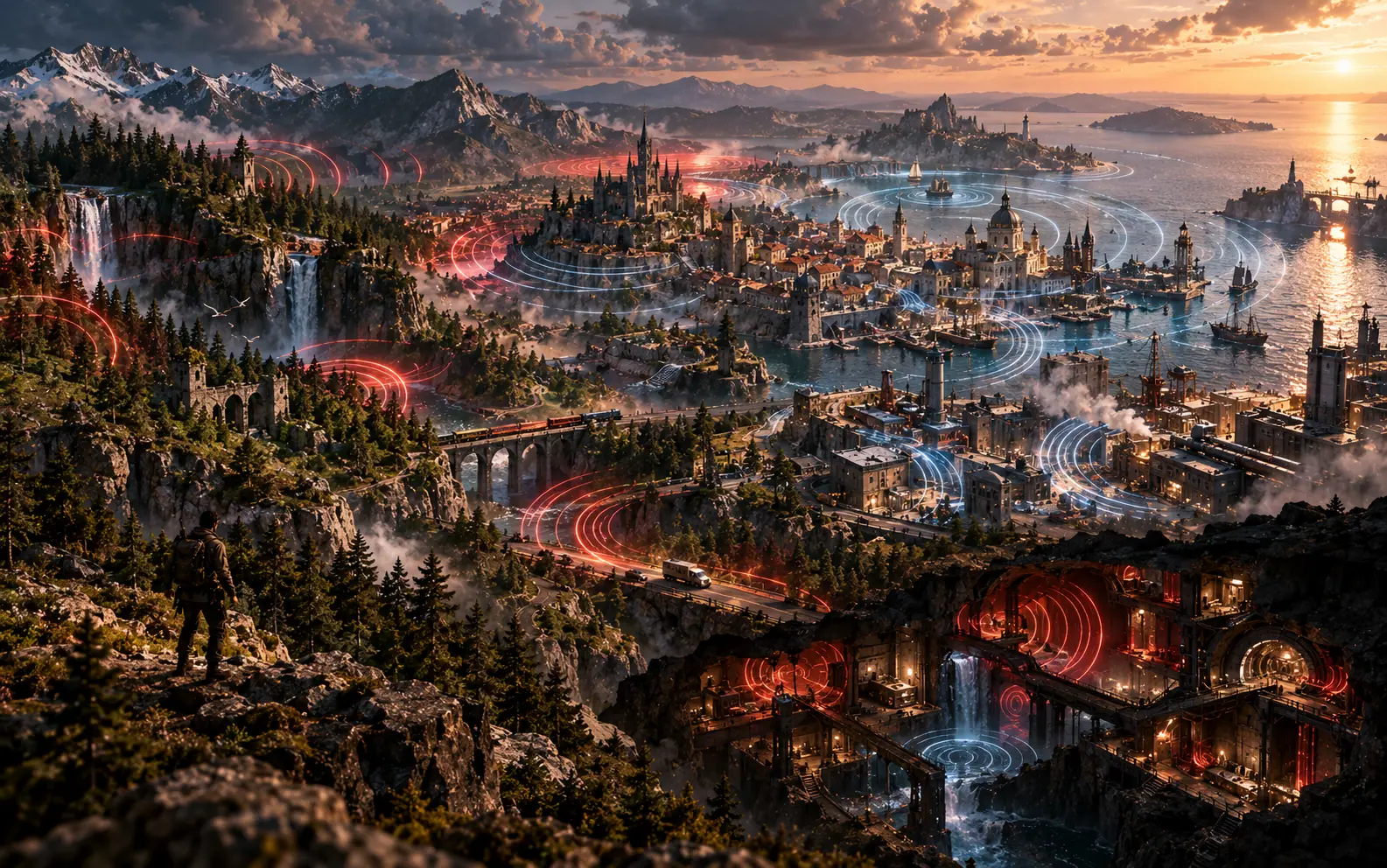
The future is unlikely to be just about making sounds higher quality.
It is about making them more responsive.
Modern audio workflows already combine composition, sound design, programming, spatial systems, procedural techniques and real-time implementation. GDC's current audio track explicitly includes interactive music, spatial audio, technical audio, programming and emerging AI-assisted workflows.
Unreal Engine's MetaSounds is one example of this direction, providing a procedural audio system designed to give creators detailed control over sound generation and behavior.
Tools such as Wwise and FMOD are also built around the idea that audio should react to gameplay rather than simply play alongside it.
The result could be games where sound behaves less like a soundtrack attached to a world and more like another simulation running inside it.
Frequently Asked Questions About Game Audio
Game audio combines music, sound effects, environmental sound, dialogue and technical systems that respond to what players do. These answers explain how those elements work together to create atmosphere, feedback and immersion.
Why is sound important in video games?
Sound provides information, atmosphere and emotional context. It can communicate actions, environmental changes, danger, movement and narrative events while also making a game world feel more believable.
What is game sound design?
Game sound design is the creation and implementation of sounds used throughout a game, including footsteps, weapons, vehicles, environmental effects, interface sounds, impacts and other interactive audio.
What is adaptive music?
Adaptive music changes or responds to gameplay conditions. Systems such as Wwise and FMOD can connect musical behavior to game states and player actions, allowing music to transition, layer or change as gameplay changes.
What is Foley in games?
Foley is the recording of performed physical sounds that can be used to create believable movement and interaction audio. Game-audio professionals use field and Foley recording to create original source material for sound design.
What is spatial audio?
Spatial audio describes techniques that help position sounds within a three-dimensional environment. Modern game-audio systems can model effects such as reflections, obstruction, diffraction and transmission through geometry.
How does music react to gameplay?
Interactive music systems can switch between musical states, transition between segments, layer musical parts or respond to gameplay parameters. Wwise, for example, supports music structures that respond to game state and intensity.
Why are footsteps different on different surfaces?
Games can associate different sounds with different surface materials. Unreal Engine's MetaSounds documentation, for example, describes systems where physical materials can determine which footstep sound is played.
How does audio help accessibility?
Audio can communicate information that might otherwise be presented visually. The Last of Us Part II, for example, includes traversal and combat audio cues alongside other accessibility options designed to communicate gameplay information through sound.
Is game music just background music?
Not necessarily. In interactive games, music can respond to gameplay, change with different situations and contribute directly to pacing and emotional context. Modern audio systems are designed specifically to make music interactive rather than simply playing a fixed recording from beginning to end.
What tools are used to make game audio?
Game developers use a combination of digital audio workstations, game engines and dedicated audio middleware. Wwise and FMOD are examples of systems designed for implementing interactive game audio, while Unreal Engine also provides native tools such as MetaSounds.

Junaid
Founder & Editor-in-Chief at Barlin Games
Founder and Editor-in-Chief of Barlin Games, covering games, studios, developers, gaming culture, and the stories behind the industry.