BARLIN GAMES PLAY. CREATE. INSPIRE.
Company / Studio Featured

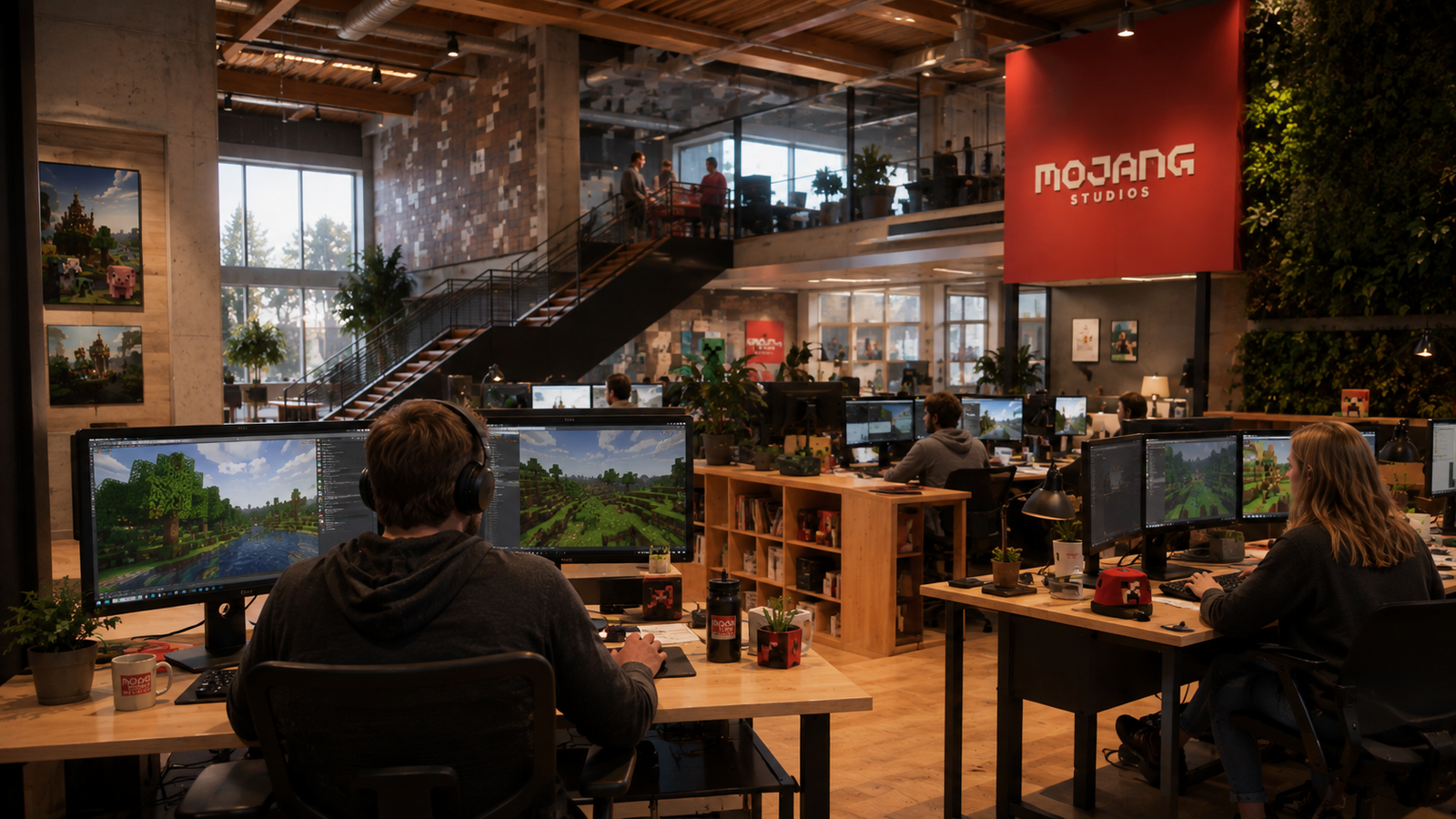
Mojang Studios: The Story Behind the Company That Created Minecraft

Discover the story of Mojang Studios, the company behind Minecraft, from its beginnings in Stockholm to Microsoft's $2.5 billion acquisition and its evolution into a global game studio.
Junaid Founder & Editor-in-Chief · 10 min read
Mojang Studios: The Story Behind the Company That Created Minecraft
On This Page Explore this article
01 — At a glance

From a small studio to a global gaming name

Mojang Studios is best known as the company behind Minecraft, but its history is much more interesting than simply being the developer of a successful game.

Mojang's story is closely connected to Minecraft's unusual rise. The game first appeared in 2009 as a PC project and gradually grew from a relatively simple block-based sandbox into a worldwide gaming phenomenon. Minecraft's full version arrived in 2011, but the ideas behind the game were already changing how players thought about creativity and open-ended gameplay.

Instead of telling players exactly what to do, Minecraft gave them a world and a collection of systems and allowed them to decide what the experience should become. One player could build a house. Another could construct an enormous city. Someone else could create a multiplayer server, experiment with redstone, explore caves, fight monsters, or simply wander through an endless world.

That freedom became a defining part of Mojang's identity. The company wasn't simply maintaining a successful game. It was maintaining a world that millions of players continuously reinvented for themselves.

2009
Minecraft first appears
2011
Minecraft 1.0 releases
$2.5B
Microsoft acquisition value
02 — The beginning

How Mojang's story started

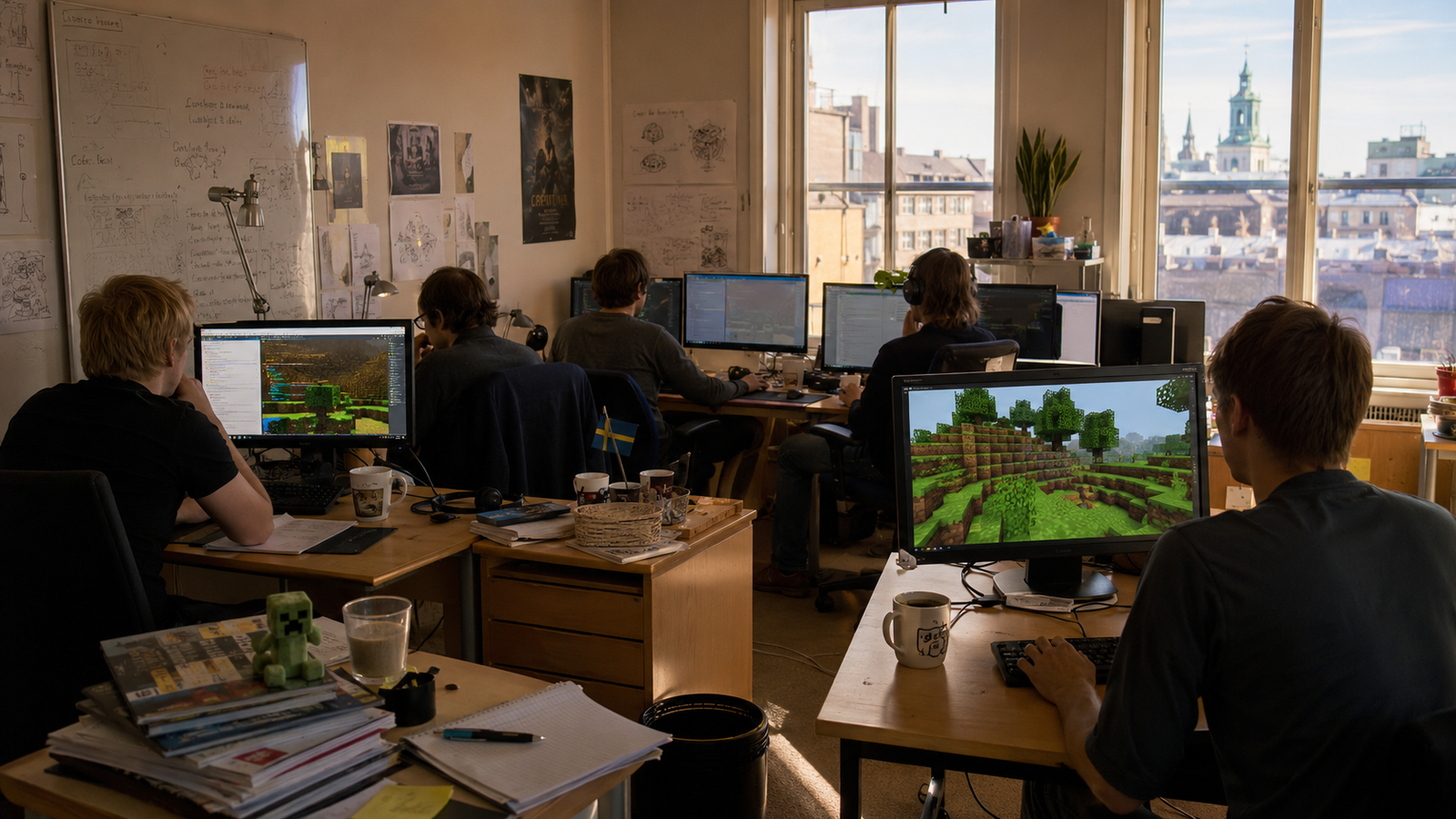
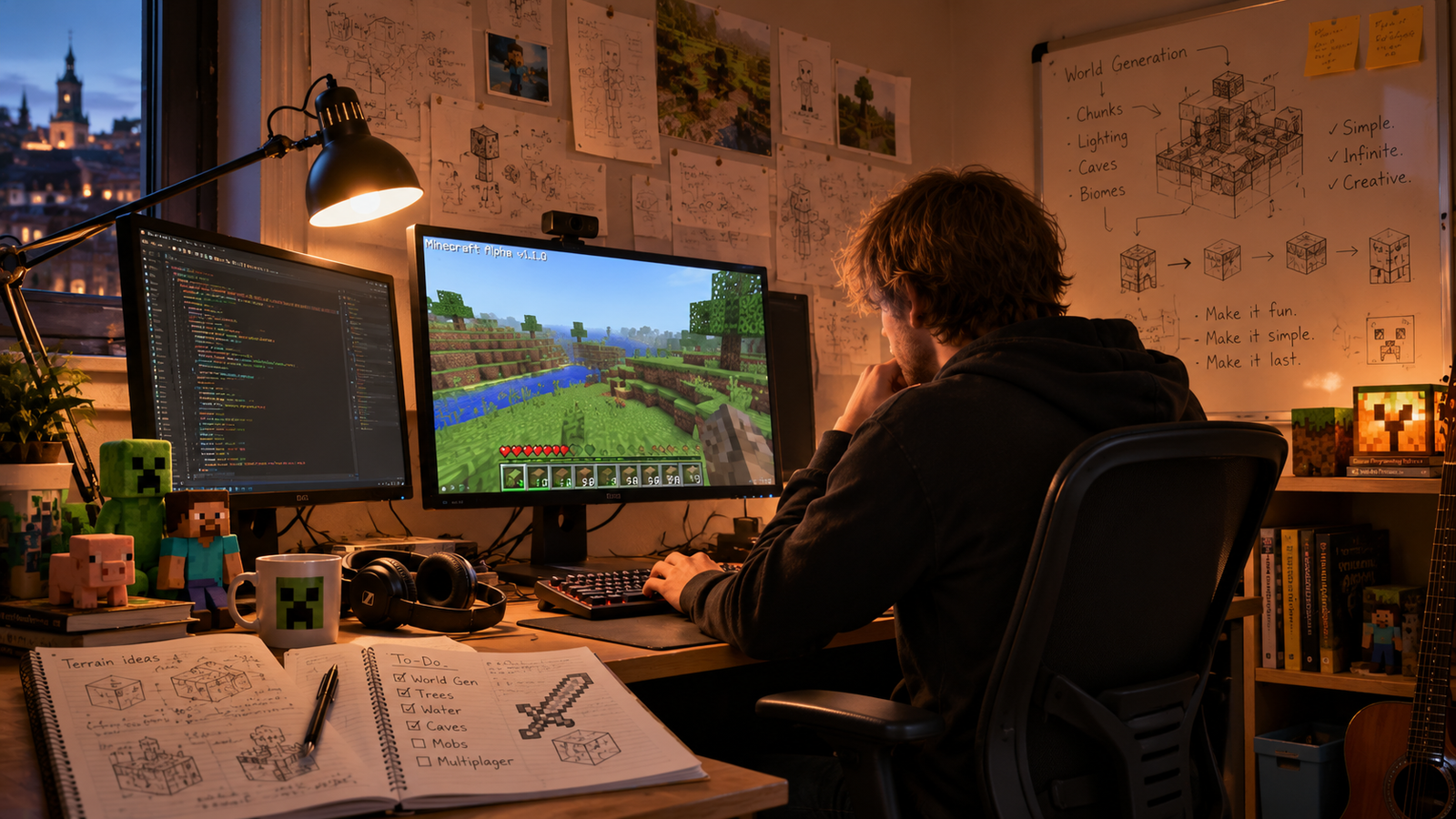
The origins of Mojang are inseparable from the early development of Minecraft. In 2009, Markus Persson began working on the project that would eventually become Minecraft. At the time, there was no obvious reason to believe that a block-based sandbox game would become one of the biggest entertainment properties in the world.

The earliest Minecraft experience was much simpler than the game players know today. Its visual style was deliberately blocky, its systems were still evolving, and much of its appeal came from the freedom it gave players to experiment.

That simplicity was important. Minecraft did not need to present players with a giant list of instructions before they could start having fun. The world itself became the tutorial. Players could mine blocks, place them somewhere else, explore their surroundings, build structures and slowly discover the rules of the game.

The project gained attention quickly. Players started sharing their experiences online, and Minecraft developed a community that helped push the game far beyond its original scope.

The idea that changed everything

Minecraft did not give every player the same story. It gave players the tools to create their own stories. That distinction became one of the most important reasons the game could remain relevant for years instead of being consumed once and forgotten.

03 — The Minecraft timeline

Five moments that changed Mojang forever

Mojang's history can be understood through a handful of turning points that transformed the company from a small Swedish developer into a major gaming organization.

 
2009

Minecraft appears

Minecraft first appears on PC. The project begins developing an audience around its unusual combination of exploration, building and open-ended creativity.

 
2011

Minecraft 1.0 arrives

Minecraft reaches its full 1.0 release. By this point, the game has already developed a strong player community and is becoming much more than a small experimental project.

 
2014

Microsoft announces the acquisition

Microsoft announces an agreement to acquire Mojang and the Minecraft franchise for $2.5 billion. The deal marks a major transition in Mojang's history.

 
2020

Mojang becomes Mojang Studios

The company introduces the Mojang Studios name and a new logo, reflecting its growth into a multi-title, multi-location organization.

 
TODAY

Minecraft remains at the center

Minecraft continues to evolve through ongoing development, new content, multiple platforms and an enormous global community.

04 — The rise of Minecraft

Why Minecraft became much bigger than a game

The easiest way to understand Mojang's success is to understand why Minecraft behaves differently from most traditional games.

A conventional game often has a clear beginning, progression system and ending. Minecraft can have all of those things, but none of them are mandatory. There is no single correct way to experience the game. Players can create their own goals and change them whenever they want.

That flexibility allowed Minecraft to become many different things to many different people.

For some players, it is a survival adventure. For others, it is a building game. Redstone enthusiasts can treat it almost like a programmable engineering sandbox. Multiplayer communities can build entire social worlds around it. Content creators can use Minecraft as the setting for videos, challenges, stories and experiments.

The game's open-ended structure also created a powerful relationship between Mojang and its community. Players were not simply waiting for developers to tell them what was coming next. They were already creating new ways to play while the game was being developed.

The world is the starting point. What happens inside it is up to the player.

Barlin Games — Editorial perspective

That player-driven nature helped Minecraft survive changes in gaming culture, hardware, platforms and generations of players. A child could discover Minecraft for the first time while an older player who had been there since the early years could still find something new to do.

05 — Microsoft

The $2.5 billion acquisition

In 2014, Mojang's story took a dramatic turn when Microsoft announced its agreement to acquire the company and Minecraft.

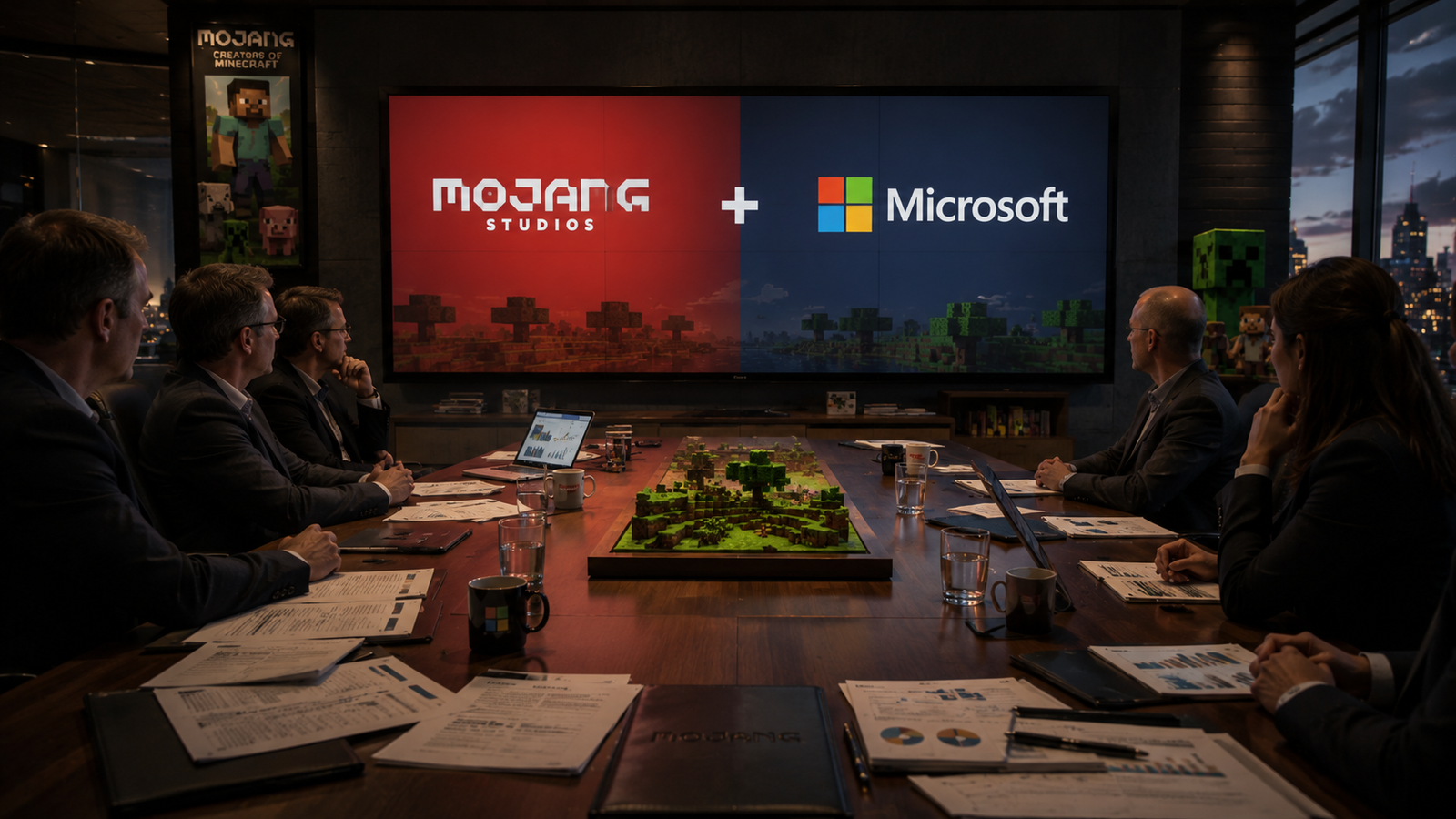
On September 15, 2014, Microsoft announced that it had reached an agreement to acquire Mojang, the Stockholm-based developer behind Minecraft. The announced value of the acquisition was $2.5 billion.

The deal was significant for a simple reason: Minecraft was already enormous. Microsoft was not buying an unknown studio and hoping that one of its games might become successful. It was buying a franchise with a huge existing audience and a remarkable ability to keep attracting new players.

Microsoft said the Mojang team would join Microsoft Studios and highlighted the potential of Microsoft's cloud and mobile technologies to support Minecraft and its community.

$

The scale of the deal

The $2.5 billion acquisition became one of the most notable gaming company acquisitions of its time and demonstrated how valuable a single long-lasting game franchise could become.

The franchise mattered

Microsoft was acquiring more than a development team. It was bringing Minecraft into its wider gaming ecosystem and gaining control of one of gaming's most recognizable properties.

06 — A new identity

Why Mojang became Mojang Studios

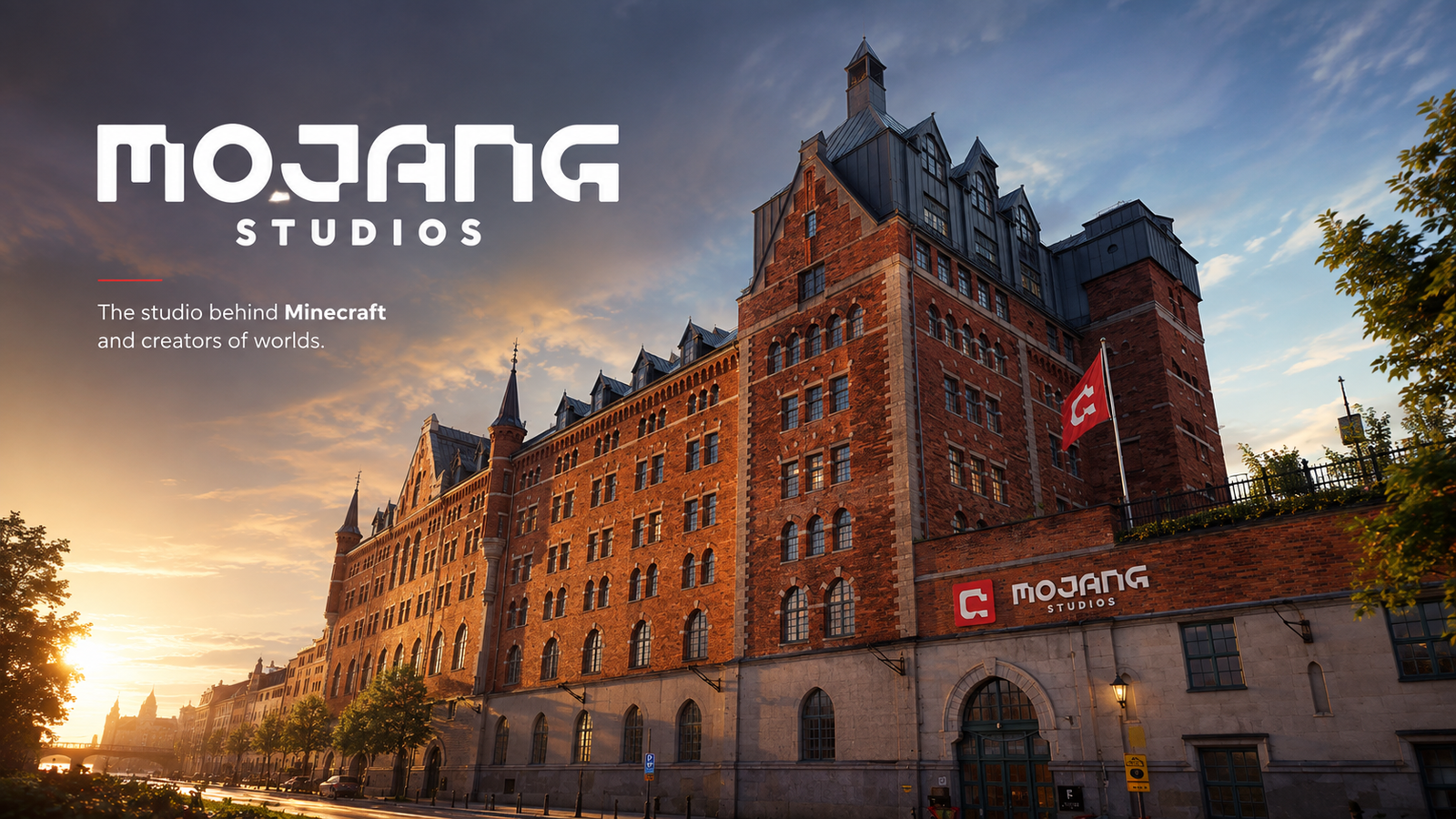
In 2020, Mojang introduced a new name, a new logo and a broader identity: Mojang Studios.

The company explained that its situation had changed dramatically since its beginnings in Stockholm. What had once been a small studio had grown into a multi-title, multi-location organization with studios around the world.

The rebrand therefore represented more than a visual refresh. It reflected the scale that Mojang had reached and the company's desire to define itself around a wider creative organization.

Mojang also described play as being at the heart of its development philosophy. That idea fits naturally with Minecraft, where experimentation and creativity are central to the experience.

From one studio to a studio network

The word “Studios” mattered because Mojang was no longer simply the small Stockholm company associated with Minecraft's earliest years. Its organization had expanded, its projects had expanded, and its creative ambitions had expanded with them.

07 — Beyond the original game

Mojang's Minecraft universe expanded

Minecraft became the foundation, but Mojang explored other ways of using the franchise.

Minecraft

The open-world sandbox that became the foundation of Mojang's identity and the central experience of the Minecraft franchise.

Minecraft Dungeons

An action-oriented dungeon-crawling experience that took the Minecraft universe into a different genre.

Minecraft Legends

A strategy-focused experience that explored another interpretation of Minecraft's world and characters.

Minecraft Education

An education-focused version of Minecraft designed around learning, collaboration and classroom experiences.

08 — What makes Mojang different

The unusual economics of a long-running game

Mojang's biggest challenge is not simply creating something new. It is continuing to develop something that millions of people already know extremely well.

Minecraft has accumulated years of mechanics, communities, memories, player creations and expectations. Every major change therefore has to work within an ecosystem that is much larger than the original game.

That creates an unusual development problem. Mojang needs to add new reasons for players to return without destroying the familiarity that makes Minecraft recognizable in the first place.

Challenge Why it matters
Long-term updates Players expect the world to continue evolving.
Multiple platforms Minecraft needs to remain accessible across different devices.
Community expectations Players have strong opinions about how Minecraft should evolve.
Creative freedom New features need to create possibilities without limiting existing creativity.
Legacy Every new generation discovers Minecraft alongside long-time players.

This is one reason Minecraft's longevity is so interesting. The game is not simply being preserved as a historical product. It continues to be developed while simultaneously carrying more than a decade of history with it.

09 — Mojang today

Where Mojang Studios stands now

Mojang Studios now operates as part of Microsoft's wider gaming organization, with Minecraft remaining the defining franchise at the center of its work.

The studio's position today is very different from where it started. In 2009, Minecraft was an experimental project trying to find an audience. Today, Minecraft is an established global gaming ecosystem with a community that spans generations.

That scale changes the job of the developer. Mojang is no longer simply trying to prove that Minecraft can succeed. It has to keep the experience relevant while protecting the qualities that made players care about it in the first place.

The official Minecraft site continues to describe the game as an open-world sandbox and confirms that the game continues to receive updates. That ongoing development is a major part of why Mojang's story is still being written rather than sitting entirely in the past.

The question Mojang faces now

The difficult question is no longer whether Minecraft can become successful. It already did. The harder question is how you keep one of the world's most recognizable games feeling like a place where players can still discover something new.

10 — FAQ

Frequently asked questions about Mojang Studios

Who created Minecraft?

Minecraft began as a project created by Markus Persson, widely known as Notch. The project eventually became the foundation of Mojang's best-known franchise.

When was Minecraft first released?

The first version of Minecraft appeared in 2009 for PC players. Minecraft 1.0, the full version, released in 2011.

Who owns Mojang Studios?

Mojang Studios is owned by Microsoft. Microsoft announced its agreement to acquire Mojang and the Minecraft franchise for $2.5 billion in September 2014.

When did Mojang become Mojang Studios?

Mojang introduced the Mojang Studios name and new logo in 2020, explaining that the company had grown into a multi-title, multi-location organization.

What is Mojang Studios best known for?

Mojang Studios is best known for Minecraft, the open-world sandbox game that became the foundation of the studio's global identity.

What other Minecraft games has Mojang worked on?

Mojang's broader Minecraft portfolio has included projects such as Minecraft Dungeons and Minecraft Legends, alongside the main Minecraft experience and Minecraft Education.

Barlin Games — Company Profile

Mojang didn't just create a game. It created a world players could keep building.

From its early Stockholm beginnings to Microsoft's $2.5 billion acquisition and the creation of Mojang Studios, the company's story is inseparable from Minecraft's evolution.

The most interesting part of Mojang's history is not simply that Minecraft became successful. It is that the game became a canvas for millions of people to create their own experiences. That relationship between developer, game and community is what turned Minecraft from a small experimental project into a lasting part of gaming culture.

Junaid
About the author

Junaid

Founder & Editor-in-Chief at Barlin Games

Founder and Editor-in-Chief of Barlin Games, covering games, studios, developers, gaming culture, and the stories behind the industry.

6 Articles Published
1+ Readers
Love this article? Building a better way to discover games. View all articles