BARLIN GAMES PLAY. CREATE. INSPIRE.

SEGA: The Story Behind Gaming's Most Iconic Underdog

From arcade machines and the Mega Drive to Sonic, Dreamcast and beyond, discover how SEGA became one of gaming's most influential companies—and survived after leaving the console business.
Junaid Founder & Editor-in-Chief · 18 min read
SEGA: The Story Behind Gaming's Most Iconic Underdog
On This Page Explore this article
01 — THE UNDERDOG

SEGA was never supposed to win

For decades, SEGA built its identity around doing what the safer companies were unwilling to do. It experimented with arcades, hardware, 3D graphics, online gaming and unusual game concepts — often taking enormous risks in the process.

SEGA's story is one of the strangest in video game history. The company became famous for competing directly with the biggest names in the industry, but its roots were nowhere near the modern console business.

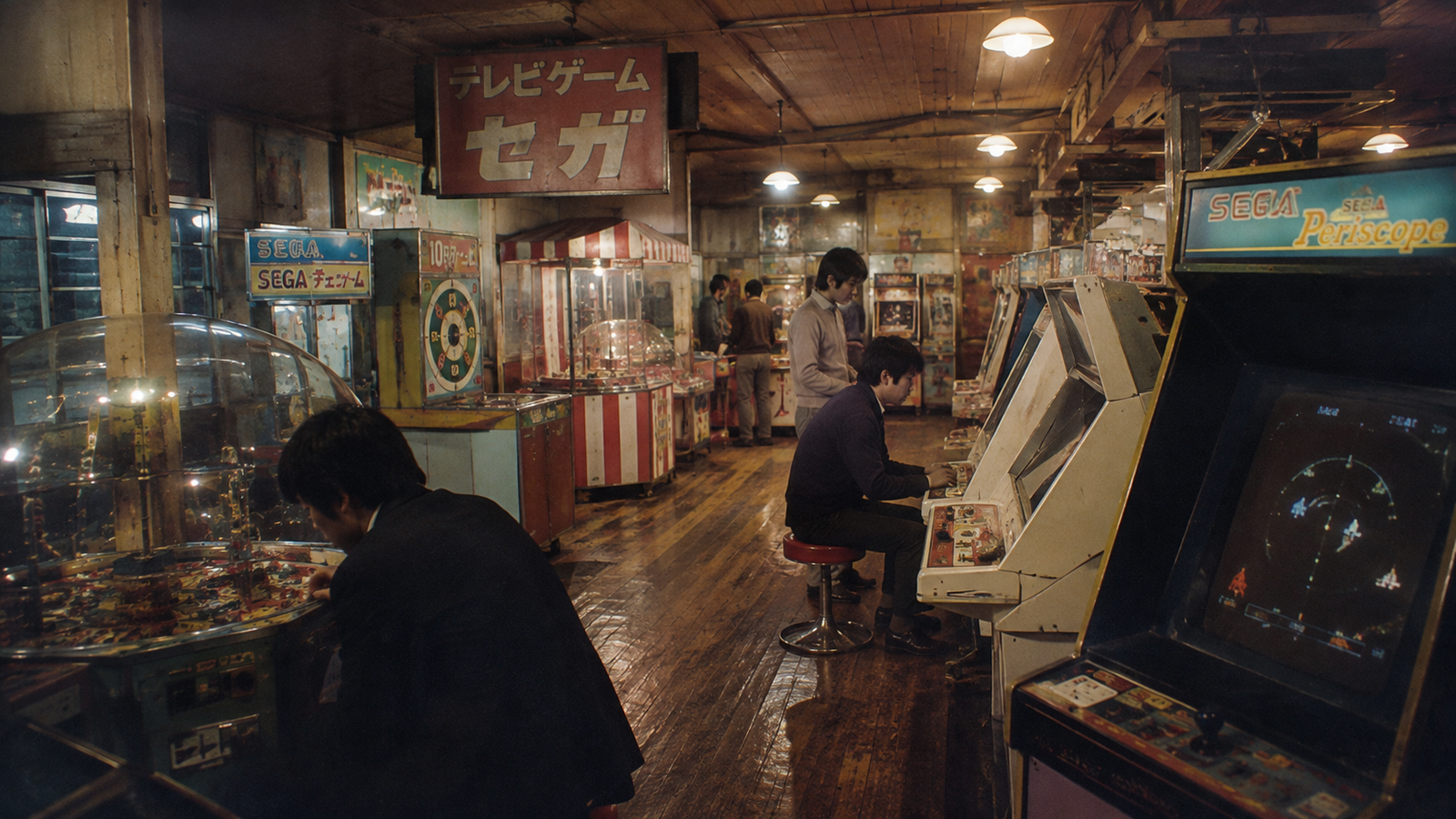
The company traces its history to 1960, when Nihon Goraku Bussan was established in Japan. Its predecessor businesses were involved in amusement equipment, and the SEGA name itself came from "Service Games." One of the early products associated with the company was the SEGA 1000 jukebox, developed as a domestically produced alternative to imported machines.

From those beginnings, SEGA moved deeper into amusement machines and arcade entertainment. That decision would shape almost everything that followed.

Long before SEGA became the home of Sonic the Hedgehog, it was a company learning how to make entertainment machines that demanded attention in public spaces.

1960SEGA's predecessor is established in Japan.
1966Periscope becomes an international arcade success.
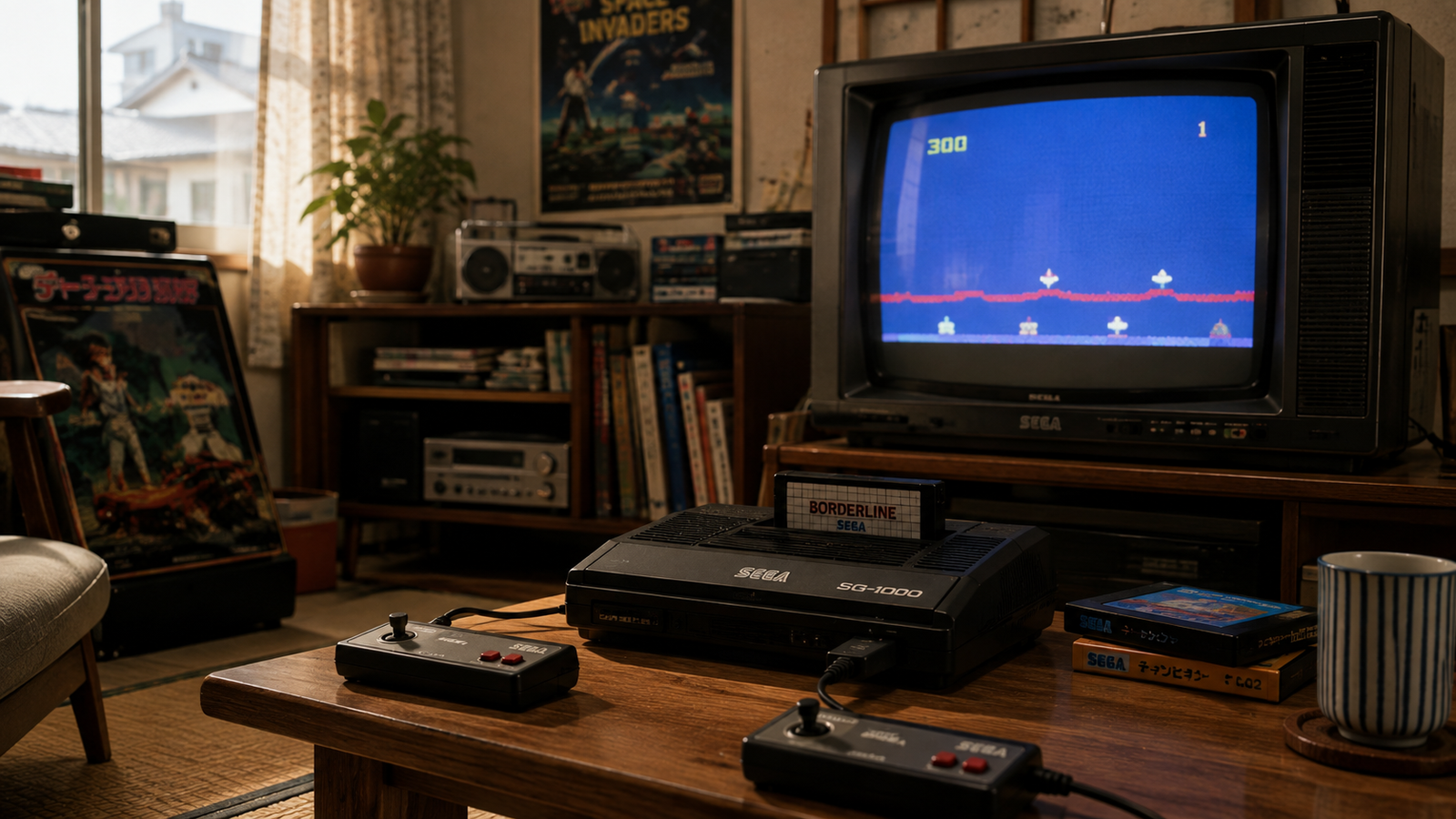
1983SEGA enters the home console market with SG-1000.
02 — BEFORE CONSOLES

The company that learned to build excitement

The arcade business gave SEGA something that would become central to its identity: a willingness to experiment with the physical experience of play.

In the 1960s, SEGA developed and operated amusement machines at a time when electronic entertainment was still a relatively new idea. Its electromechanical game Periscope became an important international success and helped establish SEGA as a serious name in arcade entertainment.

The arcade environment encouraged a different kind of design philosophy. Games needed to attract attention immediately. Machines needed to feel different from everything standing beside them. A successful cabinet was not simply software; it was an experience that could make someone stop, watch and put a coin into the machine.

That philosophy remained visible in SEGA's later arcade work. The company repeatedly experimented with motion, perspective, physical controls and increasingly sophisticated graphics.

THE SEGA APPROACH

Make the machine part of the experience.

SEGA's arcade heritage encouraged the company to treat hardware, presentation and gameplay as parts of the same entertainment experience.

03 — HOME GAMING

SEGA enters the living room

The arcade business had taught SEGA how to create spectacle. The home console market would force the company to learn how to build a platform.

In 1983, SEGA released the SG-1000, entering a home video game market that was beginning to develop rapidly in Japan.

The move represented a major shift. Arcade machines were controlled environments where SEGA could determine the hardware, cabinet and experience. Home consoles were different. They competed for space in people's living rooms and depended heavily on software libraries, distribution and long-term customer support.

SEGA continued developing its home hardware strategy through systems such as the Master System and its regional variations.

The company faced intense competition, particularly from Nintendo. That competition would eventually force SEGA to define what made its platform different.

SEGA did not enter the console business because the market was easy. It entered because the company wanted a larger stage.

04 — MEGA DRIVE

The 16-bit gamble

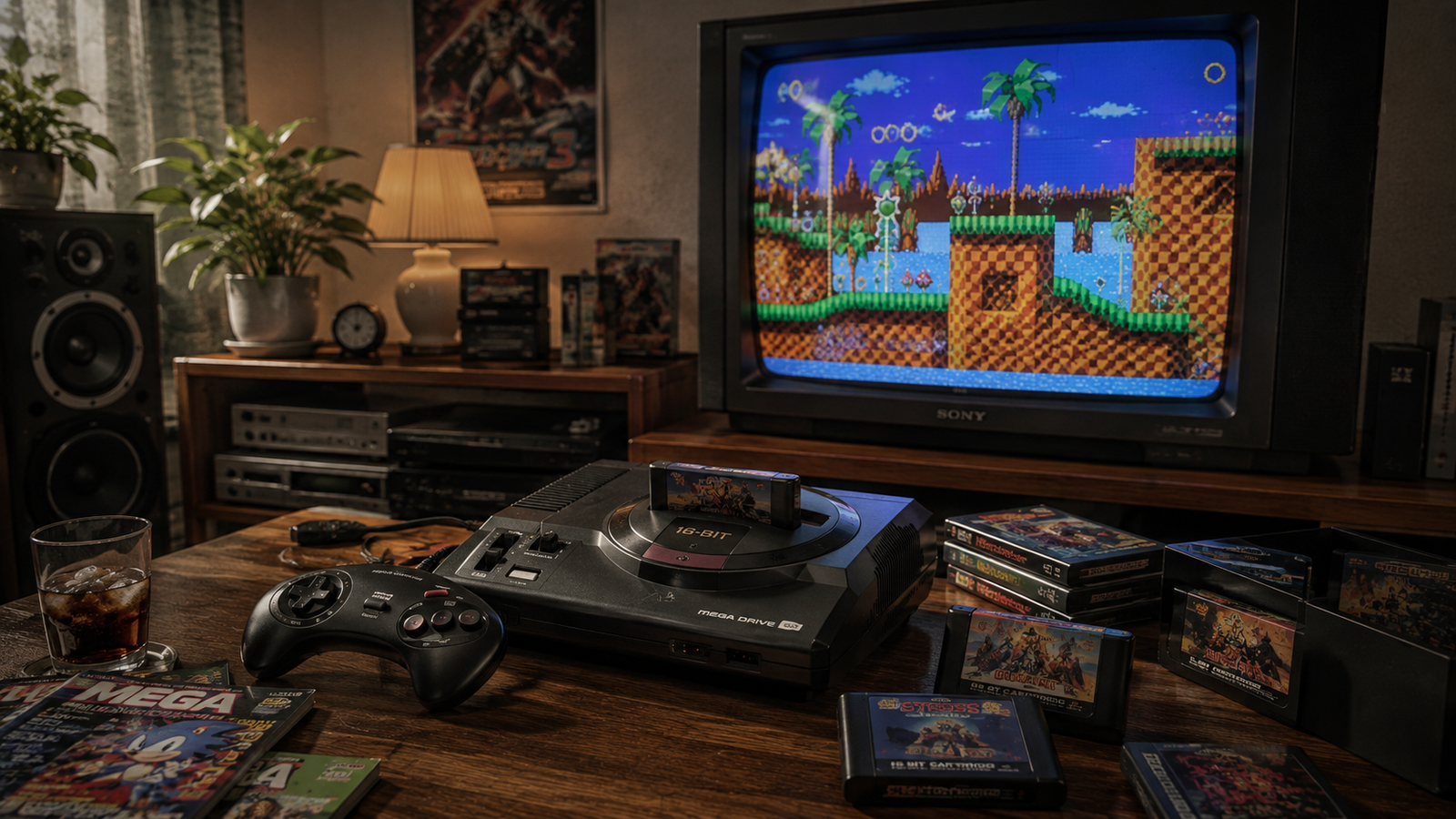
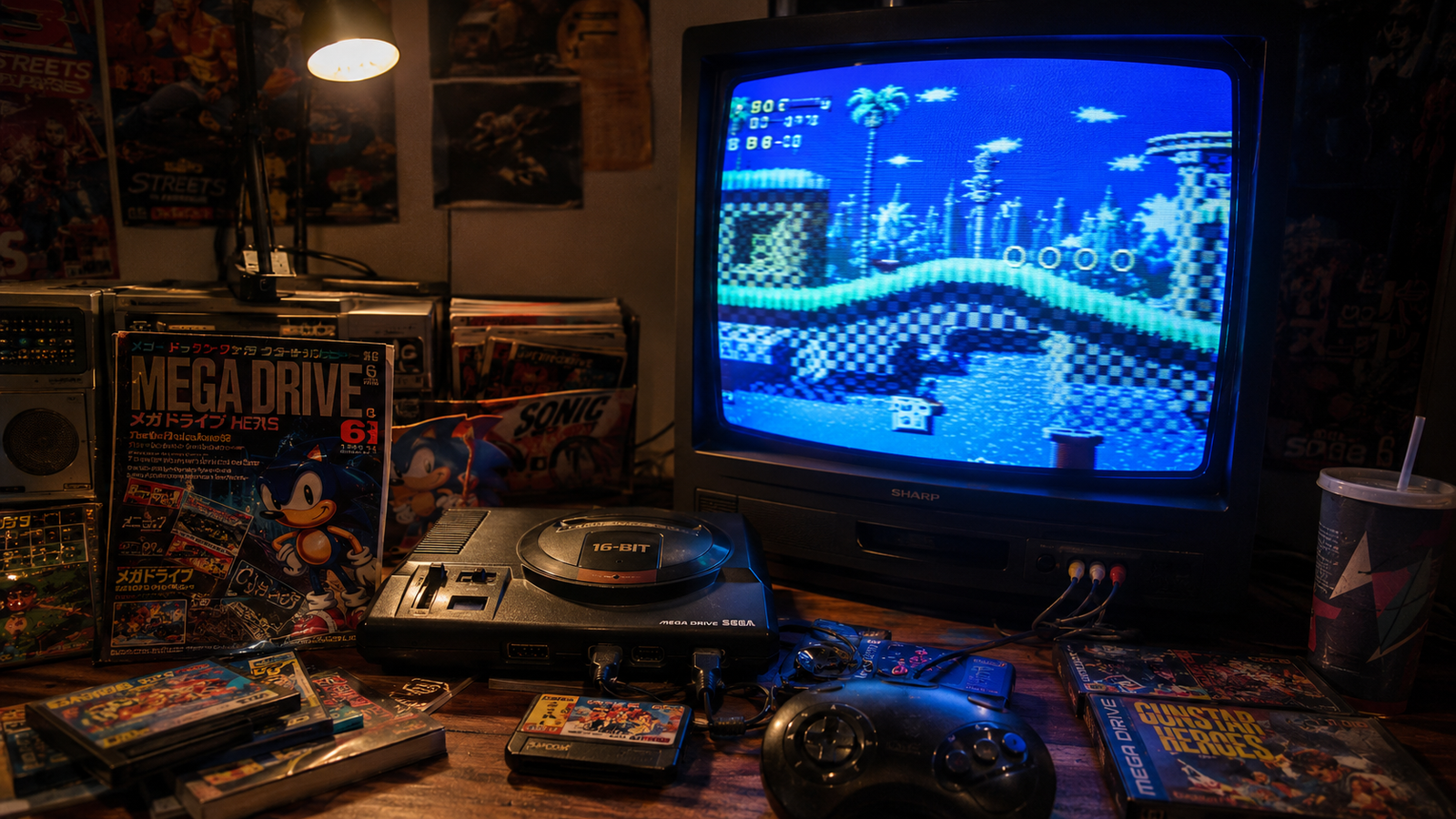
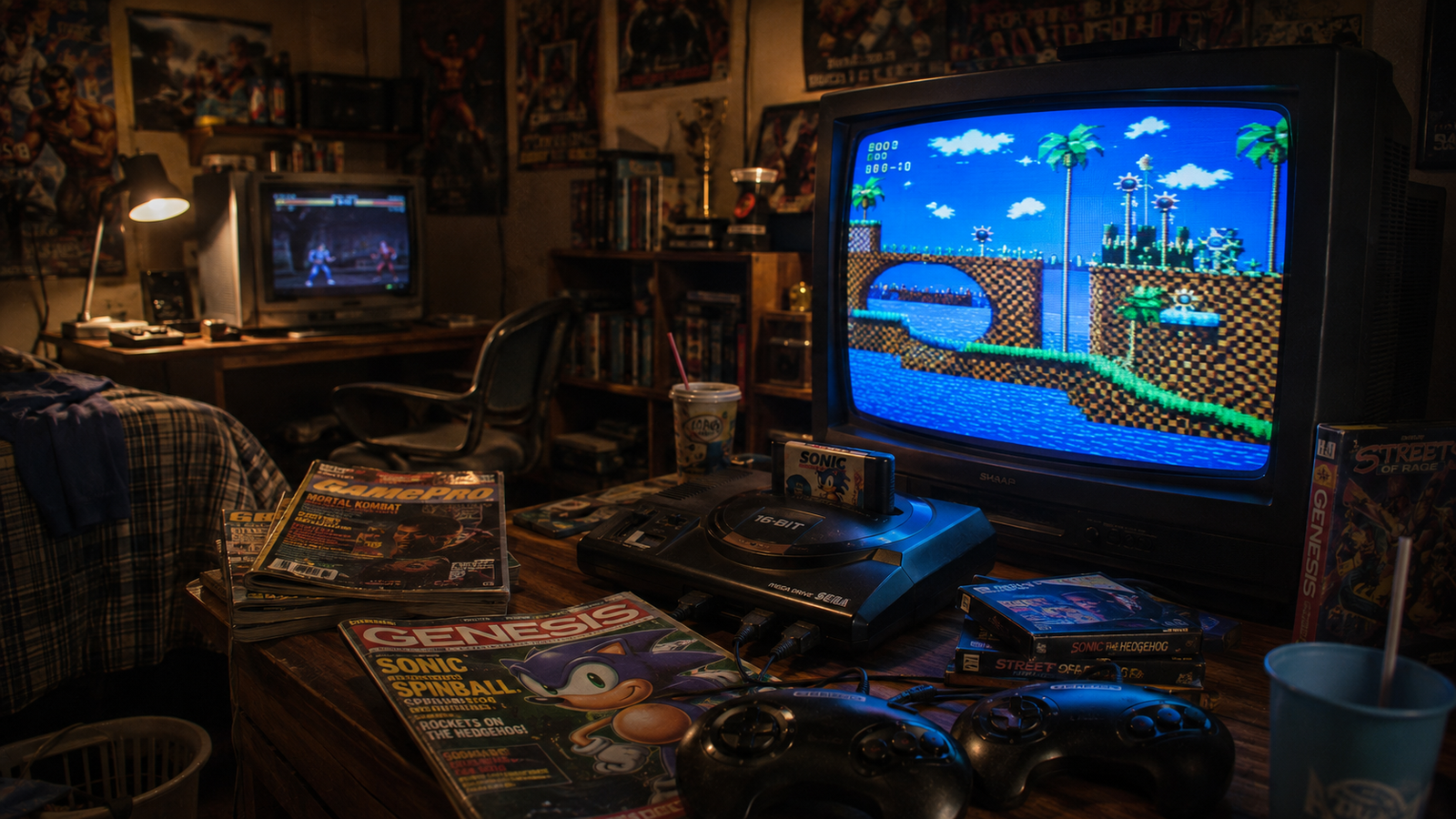
In 1988, SEGA released the Mega Drive in Japan. The system became the foundation of the company's biggest challenge to Nintendo and was later released in North America as the Genesis.

The hardware was built around a powerful 16-bit architecture for its time, and SEGA positioned the machine as a more aggressive alternative to the family-oriented image associated with its primary competitor.

The strategy was not simply about technical specifications. SEGA needed an identity.

Its marketing increasingly emphasized speed, attitude and arcade-style action. The company wanted players to see SEGA as the more rebellious alternative.

16-BITMega Drive hardware defined SEGA's next console generation.
GENESISThe North American name became central to SEGA's international identity.
ARCADE DNASEGA used its arcade heritage as a major part of its console strategy.
05 — SONIC

Then came the character that changed everything

SEGA needed a face for its hardware. Instead, it created one of the most recognizable characters in entertainment.

When Sonic the Hedgehog arrived in 1991, he was more than another platforming character. Sonic was designed to communicate speed, attitude and personality almost instantly.

The character's visual identity was deliberately different from Nintendo's most recognizable mascot. Sonic was blue, fast and expressive, and his games were built around momentum rather than the slower, more deliberate movement associated with many traditional platformers.

SEGA's own history describes the Sonic project as an attempt to create a character and game capable of showcasing the Mega Drive's capabilities while establishing a recognizable identity for the company.

The gamble worked.

Sonic became the symbol of SEGA's console era, and the character helped turn the Mega Drive and Genesis into major international platforms.

SONIC

A mascot built around motion

Sonic gave SEGA something it had been missing: a character who could represent the company's personality in a single image.

06 — THE CONSOLE WAR

SEGA learned how to fight for attention

The 16-bit era turned the competition between SEGA and Nintendo into one of the defining rivalries of the video game industry.

SEGA's strategy was unusually confrontational. The company positioned itself as the alternative to Nintendo, targeting an audience that wanted faster games, stronger action and a more rebellious identity.

The rivalry became bigger than individual games. It became a battle between two different ideas of what a video game company could represent.

Nintendo emphasized its own characters, carefully managed software ecosystem and broad family appeal. SEGA pushed speed, arcade energy and a sharper marketing personality.

For a period, that contrast made the industry feel like a genuine two-sided competition.

SEGA

Speed

Arcade energy, aggressive marketing and fast action.

THE ERA

Rivalry

Two companies competing to define the future of console gaming.

07 — ARCADE INNOVATION

SEGA's strangest ideas often started in arcades

While the console business was becoming increasingly competitive, SEGA continued pushing arcade technology.

The company developed experiences that used motion, advanced graphics and unusual physical controls. This approach produced games that could feel almost impossible to reproduce at home.

Hang-On, Out Run and other arcade projects demonstrated SEGA's interest in creating experiences where the cabinet itself became part of the attraction.

That philosophy reached another level in the 1990s when SEGA began experimenting with real-time 3D graphics.

The company's arcade division would eventually produce one of its most technically important achievements: Virtua Fighter.

08 — 3D GAMING

When SEGA helped make 3D feel real

In 1993, SEGA introduced Virtua Fighter, described by SEGA as the world's first 3D computer graphics fighting game.

The importance of Virtua Fighter went beyond the fighting game genre. It demonstrated what polygonal characters and real-time 3D environments could look like in an arcade environment.

At a time when 2D sprites still dominated many games, SEGA was already experimenting with a future built around polygons.

3DPolygonal characters and environments.
ARCADETechnology designed to make players stop and look.
RISKA willingness to invest before the market was fully proven.

This willingness to experiment would become one of SEGA's defining characteristics during the 1990s.

09 — SATURN

The Saturn arrives at the wrong moment

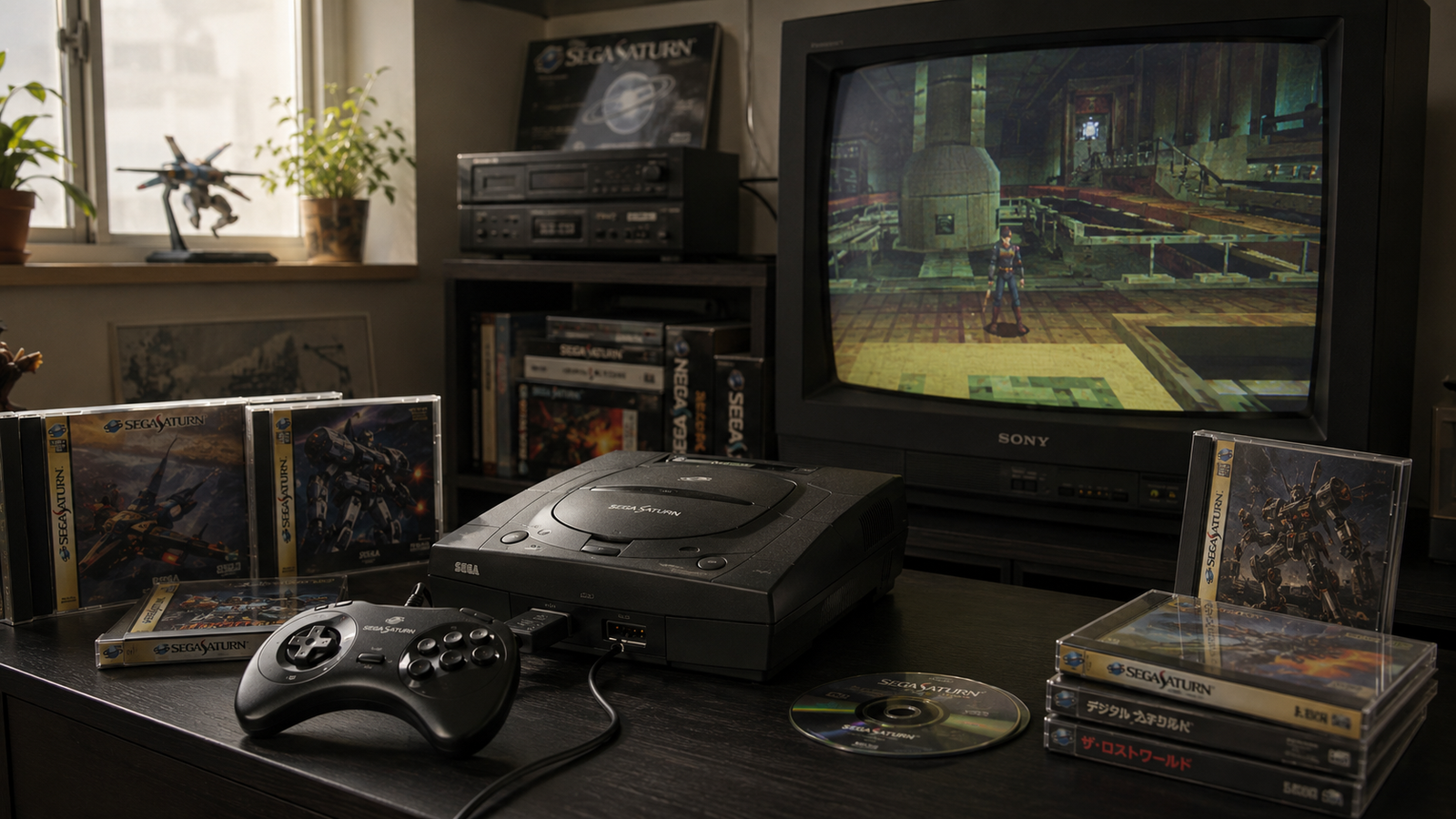
SEGA released the Saturn in 1994, entering a new generation of console hardware just as the industry was beginning to move toward increasingly sophisticated 3D graphics.

The Saturn was capable of impressive experiences, especially in genres where its architecture and SEGA's arcade expertise could be used effectively.

But the transition into a new generation was complicated.

The market was becoming more competitive, new companies were entering the console business and consumers were beginning to pay close attention to 3D technology.

SEGA's position became increasingly difficult as the company attempted to balance its existing strengths with a rapidly changing hardware landscape.

THE PROBLEM

Innovation alone could not guarantee momentum.

SEGA's hardware ambitions were often ahead of the market, but successful platforms also required timing, software support, clear communication and a strong long-term strategy.

10 — DREAMCAST

SEGA's boldest console was also its last

The Dreamcast was not a retreat. It was SEGA making one more enormous bet.

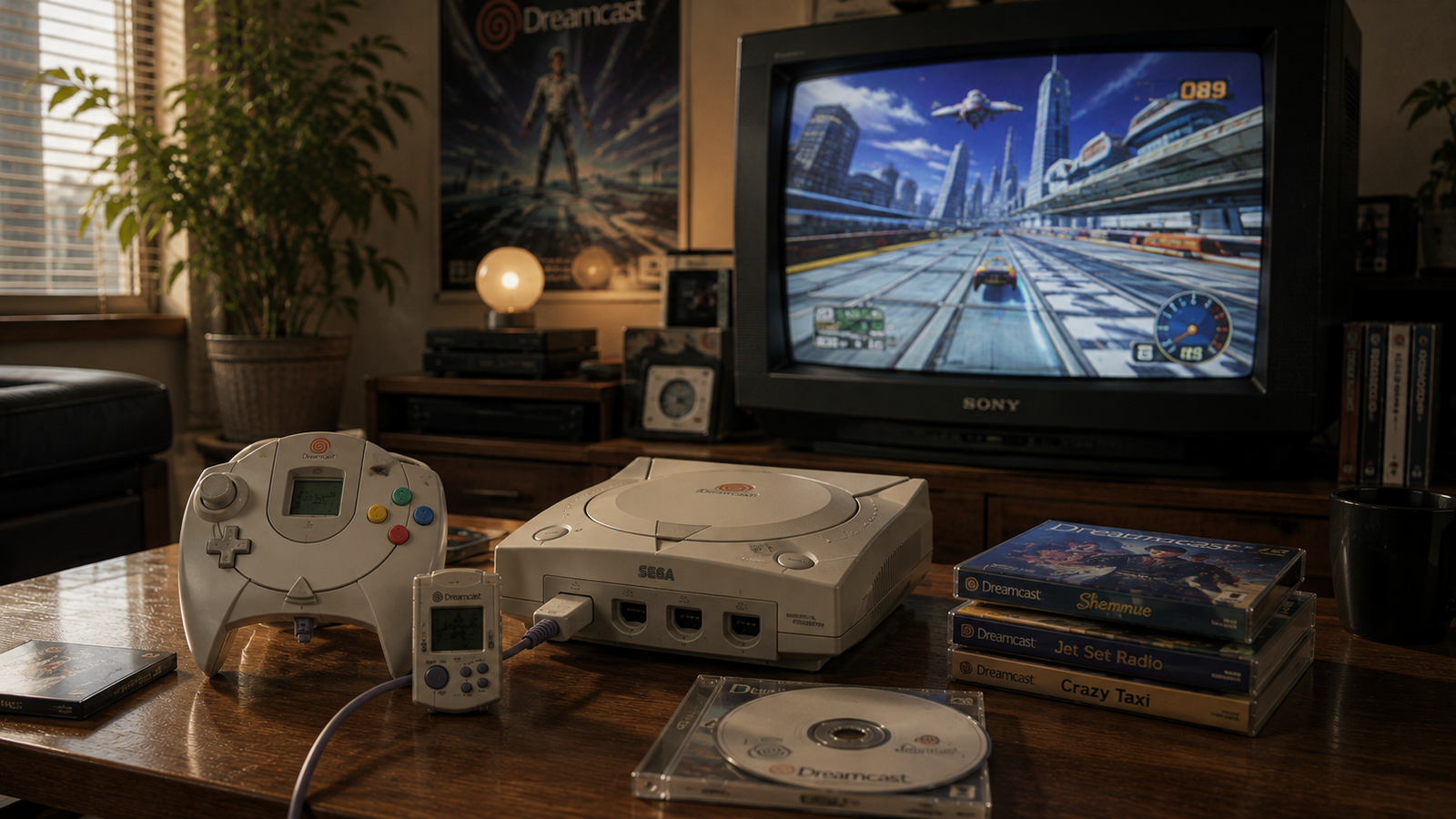
Released in Japan in 1998, Dreamcast represented SEGA's attempt to rethink what a console could be at the beginning of a new technological era.

SEGA built the system around online communication capabilities and supported it with games that were unusually ambitious in their design.

Shenmue pushed toward detailed 3D environments and open-ended exploration. Phantasy Star Online demonstrated how console players could participate in online cooperative experiences.

Other projects such as Seaman showed that SEGA was still willing to create games that did not fit comfortably into conventional categories.

1998

Dreamcast

SEGA's final dedicated home console combined ambitious hardware, online functionality and experimental software.

In many ways, Dreamcast represented SEGA at its most creative. The problem was that creativity alone could not overcome the increasingly difficult economics and competition of the console market.

11 — THE TURNING POINT

When SEGA stopped making consoles

The Dreamcast ultimately became the final chapter of SEGA's dedicated console hardware era.

By the beginning of the 2000s, SEGA was facing a difficult position. Maintaining a hardware platform required enormous investment, while competing software publishers could increasingly release games across multiple systems.

SEGA eventually abandoned the console hardware business and shifted toward becoming a third-party game developer and publisher.

The decision changed the company's identity more dramatically than any previous transition.

For years, SEGA had defined itself through the battle between its own hardware and Nintendo's platforms. Now its games could appear on competing systems.

THE PIVOT

From hardware manufacturer to software company.

The decision looked like the end of SEGA's console story. Instead, it opened the door to a completely different chapter.

12 — AFTER THE CONSOLE

The company discovered a second life

Once SEGA stopped producing its own consoles, the company could concentrate on the part of the business that had always been at the center of its identity: games.

Franchises that had once existed primarily to sell SEGA hardware could now reach audiences on competing platforms.

Sonic became the clearest example. The character that had once represented SEGA's fight against Nintendo could now appear on Nintendo systems as well as other platforms.

That transformation was almost impossible to imagine during the height of the console wars.

The former underdog had effectively stopped fighting the hardware battle and started competing through its software library instead.

SONICThe character that survived the hardware transition.
YAKUZAA new identity built around story, characters and detailed urban worlds.
PHANTASY STARSEGA's long-running connection to RPGs and online experiences.
13 — SEGA SAMMY

A new corporate chapter

In 2004, SEGA and Sammy combined their businesses to form SEGA SAMMY HOLDINGS.

The combination brought together two companies with different histories and strengths. SEGA had decades of experience in arcade machines, consoles and video game software, while Sammy had built its business around amusement and gaming-related machines.

The new structure marked another major transition in SEGA's history.

The company was no longer defined by its relationship with console hardware. Instead, SEGA became part of a broader entertainment organization with businesses spanning games, amusement and other forms of content.

14 — THE LEGACY

The first half of the SEGA story

SEGA's history is difficult to summarize because the company repeatedly reinvented itself.

It began with amusement equipment, became an arcade innovator, entered the console market, fought Nintendo, created Sonic, pushed 3D arcade technology, experimented with online gaming and eventually abandoned the hardware business altogether.

Some of its biggest risks became legendary successes. Others became expensive lessons.

But the pattern remained remarkably consistent: SEGA kept trying things that felt different.

THE SEGA DNA

Risk. Speed. Experimentation.

The company's greatest legacy may not be a particular console or franchise. It may be the willingness to take a strange idea seriously enough to build it.

15 — LIFE AFTER HARDWARE

SEGA stopped building consoles. Its games became bigger.

Leaving the hardware business looked like the end of SEGA's most important era. In reality, it gave the company something it had never fully possessed before: the freedom to put its games almost anywhere.

For most of its history, SEGA's games had been tied closely to its own hardware. Sonic, Virtua Fighter, Jet Set Radio and other franchises existed inside an ecosystem controlled by SEGA.

After the Dreamcast era, that relationship disappeared.

SEGA became a software publisher working across platforms rather than a company trying to convince customers to buy a particular piece of hardware.

The change was enormous. Instead of competing for shelf space as a console manufacturer, SEGA could compete through characters, worlds, gameplay systems and franchises.

That transition was difficult, but it also created the foundation for the modern SEGA.

THE SECOND LIFE

SEGA's most important platform became its software library.

The company could finally bring its characters and series to audiences who had never owned a SEGA console.

16 — SONIC'S SECOND LIFE

The mascot that refused to disappear

Sonic survived the transition from hardware company to software publisher better than almost any other character from the console era.

That survival was not guaranteed. Once SEGA stopped manufacturing consoles, Sonic lost the hardware platform that had originally made him a central part of the company's identity.

Instead of disappearing, the character became more widely available.

Sonic games appeared across multiple platforms, allowing SEGA to reach players who had grown up with Nintendo, PlayStation, PC and other gaming systems.

The character also expanded beyond games. Television, animation, merchandise and eventually feature films helped transform Sonic into an entertainment brand rather than simply a console mascot.

01CONSOLE ICON

Sonic became the face of SEGA's hardware era.

02MULTI-PLATFORM

The character reached audiences beyond SEGA hardware.

03GLOBAL BRAND

Sonic became larger than the console business that created him.

17 — YAKUZA

SEGA found a new identity in Kamurocho

If Sonic represented the SEGA of the console wars, Yakuza represented the company discovering what it could become afterward.

The Yakuza series, known internationally today as Like a Dragon, became one of SEGA's most distinctive modern properties.

Instead of relying on futuristic technology or arcade spectacle, the series focused on characters, crime drama, detailed urban environments and a strange mixture of serious storytelling and deliberately absurd side activities.

Its fictional districts were dense with restaurants, shops, arcades, bars and characters. The environments were designed not simply as places to fight but as spaces where players could spend time.

That approach gave SEGA something it had not always been associated with: a long-running narrative franchise built around characters and atmosphere.

SEGA's modern identity was no longer about making the fastest console. It was about making games with personality.

18 — PERSONA & ATLUS

The acquisition that expanded SEGA's world

SEGA's modern portfolio became even broader through its relationship with Atlus.

Atlus had built a reputation around role-playing games with distinctive characters, unusual worlds and a strong Japanese identity. Its franchises included Shin Megami Tensei and Persona.

SEGA acquired Atlus's parent company in 2013, bringing Atlus into the SEGA Group.

The significance of the move went beyond adding another publisher to the portfolio.

Persona in particular became one of the most internationally recognizable Japanese RPG brands, giving SEGA access to a different audience from the players who grew up with Sonic, Virtua Fighter and its arcade franchises.

A BROADER SEGA
SONICAction and platforming
YAKUZAStory-driven action
PERSONARole-playing and social simulation
PHANTASY STARScience-fiction RPG and online play
19 — CREATIVE ASSEMBLY

SEGA went west for strategy

SEGA's expansion was not limited to Japanese development.

In 2005, SEGA acquired Creative Assembly, the British studio behind the Total War series.

The acquisition gave SEGA a major presence in the PC strategy market.

Total War combined turn-based strategic planning with real-time battles and enormous historical settings. The series developed an audience very different from Sonic or Yakuza.

That difference was important.

SEGA was gradually becoming a company whose identity could not be reduced to one genre, one country or one platform.

CA

Creative Assembly

A British development studio that expanded SEGA's reach into large-scale PC strategy through Total War.

20 — PHANTASY STAR ONLINE

SEGA was experimenting with online gaming early

SEGA's interest in online gaming did not begin with modern live-service games.

Phantasy Star Online launched on Dreamcast in 2000 and became one of the console's most memorable experiments with online multiplayer.

Players could connect, form teams and explore science-fiction environments together.

The experience showed that SEGA was thinking about connected gaming before online functionality became a standard expectation for console players.

The Dreamcast ultimately failed as a hardware platform, but some of the ideas introduced during its short life anticipated the direction the wider industry would later take.

2000
Phantasy Star OnlineOne of SEGA's most important early experiments with online console gaming.
21 — THE ARCADE LEGACY

The place where SEGA never stopped being weird

Arcades remained one of the clearest expressions of SEGA's personality.

SEGA's arcade history is filled with ideas that would have been difficult to reproduce on ordinary home hardware.

Racing cabinets, motion simulators, rhythm games, fighting games and experimental control systems allowed SEGA to treat the physical machine as part of the game.

Titles such as Virtua Fighter, Virtua Racing and later arcade projects demonstrated the company's willingness to invest in technology simply because it could create an experience players could not get anywhere else.

This philosophy explains something important about SEGA's history.

The company was never purely a console company.

Its deepest roots were in amusement, experimentation and spectacle.

RACINGSpeed and physical simulation.
FIGHTINGReal-time 3D combat and competitive play.
RHYTHMMusic transformed into physical interaction.
EXPERIMENTSCabinets designed around unusual controls and ideas.
22 — MODERN SEGA

From one mascot to an entire portfolio

Modern SEGA looks almost nothing like the company that fought Nintendo during the 16-bit era.

The company now operates through a much wider collection of studios, franchises and entertainment properties.

Sonic remains the most recognizable global face, but he is only one part of the modern portfolio.

Like a Dragon provides cinematic storytelling and detailed urban worlds. Persona brings role-playing and social simulation. Total War serves the strategy audience. Phantasy Star continues SEGA's connection to science-fiction RPGs and online gaming.

Other properties and studios continue to expand the company's reach across different genres and markets.

PLATFORMPC
PLATFORMCONSOLE
PLATFORMMOBILE
MARKETGLOBAL
23 — THE STRANGE ADVANTAGE

SEGA's biggest strength may be that it already failed once

Most successful companies try to protect the formula that made them successful.

SEGA had that luxury taken away.

The company lost its position as a console manufacturer and had to rebuild its identity around software.

That painful transition forced SEGA to think differently about its franchises.

Sonic no longer had to sell a console. Yakuza did not need to compete against another hardware platform. Persona could grow independently of the old console wars. Total War could thrive on PC.

The result was a portfolio that became more diverse after SEGA's hardware collapse than it had been during the company's greatest console success.

THE PARADOX

SEGA became more flexible after losing the thing it once considered essential.

24 — THE NOSTALGIA QUESTION

SEGA is more than the Dreamcast

Modern gaming culture often remembers SEGA through nostalgia.

The Mega Drive. Sonic. The Saturn. Dreamcast. Crazy Taxi. Jet Set Radio. Shenmue. Virtua Fighter.

Those memories matter, but nostalgia can make SEGA's history look simpler than it really was.

SEGA was not simply a company that made one legendary console and then disappeared.

It was a company that repeatedly changed its business model while carrying pieces of its earlier identity into each new era.

The modern company exists because those pieces survived.

THENConsole hardware, arcade machines and the console wars.
NOWGlobal software, studios, franchises and entertainment.
25 — WHAT SEGA TAUGHT GAMING

The lessons hidden inside the chaos

01

Innovation is not enough

SEGA repeatedly introduced interesting technology, but successful platforms also require timing, software support and sustainable business decisions.

02

A strong identity matters

Sonic and SEGA's aggressive marketing showed how a company can turn personality into a competitive advantage.

03

Failure can force reinvention

Leaving the console market was painful, but it eventually allowed SEGA to build a broader software-focused identity.

04

Strange ideas can become important

Many of SEGA's most memorable games came from experiments that did not look like obvious commercial bets.

26 — THE UNDERDOG LEGACY

Why SEGA still matters

SEGA's greatest achievement may not be that it won the console war. It didn't.

SEGA's importance comes from everything it attempted along the way.

It helped turn arcades into technological showcases. It pushed console gaming toward faster action and stronger personality. It created Sonic. It experimented with 3D graphics while the technology was still developing. It explored online console gaming before it became normal.

It also experienced one of the most dramatic transformations any major gaming company has undergone.

SEGA went from hardware manufacturer to software publisher without disappearing.

That is what makes the company such an unusual underdog story.

The company lost the battle for console hardware, but it did not lose its identity.

SEGA
THE REAL LEGACY

The company that kept reinventing itself.

From amusement machines to arcades, from Mega Drive to Dreamcast, and from Sonic to a global portfolio of modern franchises, SEGA's story is ultimately about refusing to stay in one place.

That is why SEGA remains one of gaming's most recognizable names decades after its greatest hardware battle ended.

27 — FAQ

Frequently Asked Questions About SEGA

From its early arcade roots to the Mega Drive, Saturn, Dreamcast and its modern role in gaming, here are answers to the most common questions about SEGA's history, games, consoles and evolution.

When was SEGA founded?

SEGA's corporate predecessor was established in June 1960 in Japan. The company developed from businesses involved in commercial amusement equipment, eventually becoming the SEGA known for arcade games, consoles and video-game software.

What does SEGA mean?

The name SEGA comes from “Service Games,” reflecting the company's early connection to amusement equipment and games.

What was SEGA originally known for?

SEGA originally became known for commercial amusement equipment and arcade games before expanding into home consoles and video-game software.

When was the Sega Genesis released?

SEGA released the Mega Drive in Japan in 1988. The system was released as the Genesis in North America in 1989 and reached Europe in 1990.

Why was Sonic the Hedgehog important to SEGA?

Sonic became one of SEGA's defining characters and helped turn the Mega Drive and Genesis into major competitors during the 16-bit console era. Its fast gameplay and distinctive character gave SEGA a recognizable identity in its competition with Nintendo.

Why did SEGA Saturn struggle?

The Saturn faced a difficult competitive environment, technical challenges and strong competition during a generation increasingly focused on 3D gaming. Although it developed a particularly strong following in Japan, it struggled to achieve the same global success as the Mega Drive.

What was the Sega Dreamcast?

The Dreamcast was SEGA's final dedicated home console. Released in 1998, it was notable for built-in online communication capabilities and ambitious games such as Shenmue and Seaman.

Why did SEGA stop making consoles?

After the Dreamcast struggled commercially, SEGA moved away from manufacturing its own dedicated home-console hardware and shifted toward developing and publishing games for multiple platforms.

Does SEGA still make games?

Yes. SEGA remains an active game company developing and publishing content for consoles, PC, mobile and other platforms. Its current business includes major franchises and its wider SEGA Group ecosystem.

Does SEGA own Atlus?

Atlus became part of the SEGA Group in 2013. Atlus is known for franchises including Persona, Shin Megami Tensei and Etrian Odyssey.

Junaid
About the author

Junaid

Founder & Editor-in-Chief at Barlin Games

Founder and Editor-in-Chief of Barlin Games, covering games, studios, developers, gaming culture, and the stories behind the industry.
6 Articles Published
1+ Readers
Love this article? Building a better way to discover games. View all articles