
BARLIN GAMES
Feature

How AI Can Generate Worlds in Video Games

From procedural terrain and sprawling dungeons to experimental generative AI, discover how video games create virtual worlds, how developers keep them playable, and why generating more content does not automatically make a better game.
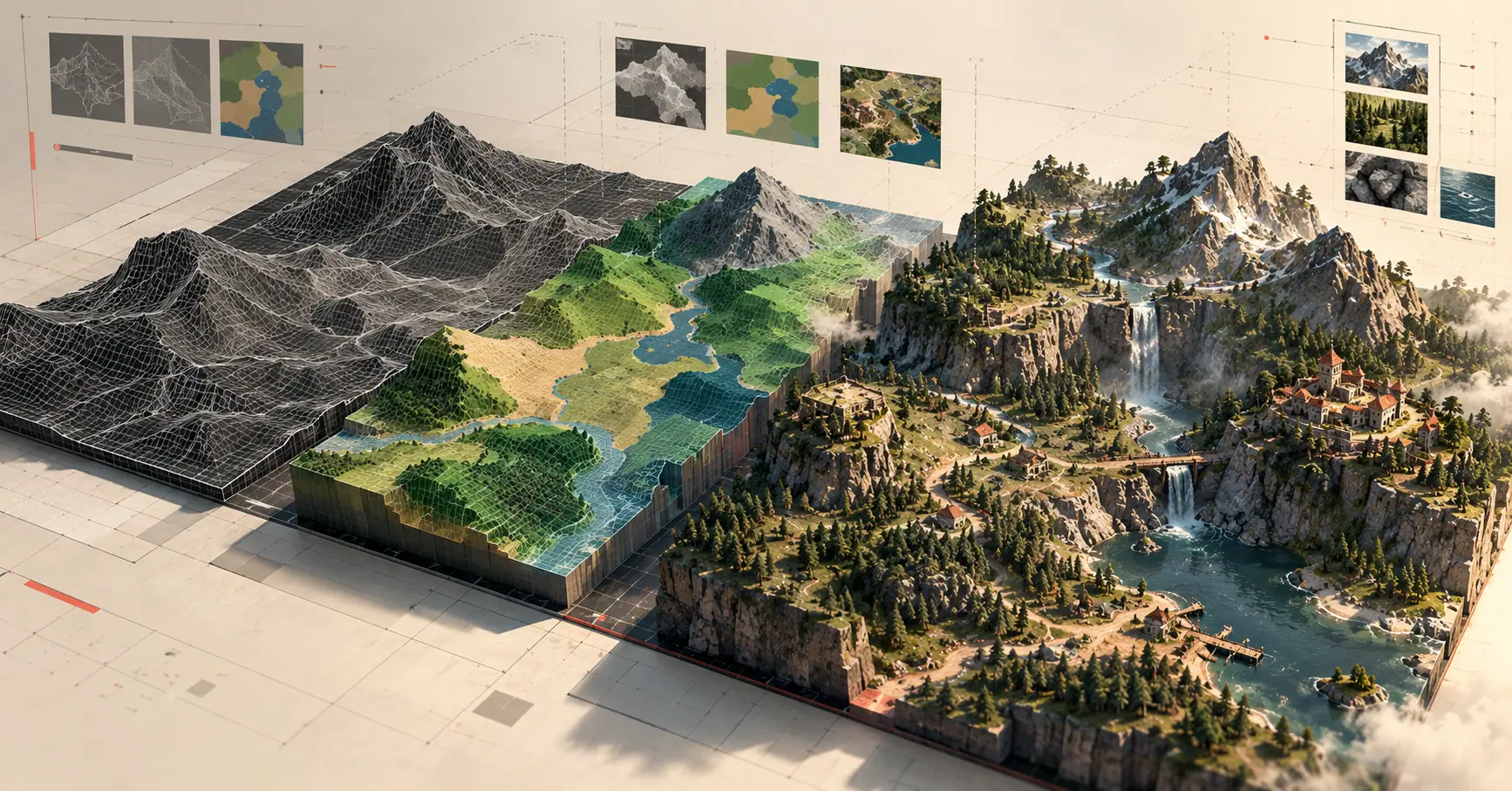
Junaid Founder & Editor-in-Chief · 13 min read
How AI Can Generate Worlds in Video Games
On This Page Explore this article
01

The Big Idea: Making a World Is More Than Filling a Map

Games can create places by hand, assemble them from rules, or use newer AI techniques to help generate content. These methods overlap, but they are not the same thing.

A game world looks effortless when it works well. A mountain range leads naturally into a valley, a road points toward a settlement, and a cave appears where a player might reasonably expect one. Behind that experience may be a large team of artists and designers—or a system that assembles some of the environment automatically.

Procedural content generation, often shortened to PCG, means using algorithms to create game content. The content might be terrain, vegetation, buildings, rooms, objects, missions, or combinations of these. A traditional procedural system can use rules, random numbers, mathematical functions, templates, and hand-authored assets. It does not need a neural network or a modern generative-AI model.

Generative AI is a newer family of approaches that can learn patterns from data and generate new outputs, such as images, text, 3D-related content, or structured designs. Researchers are exploring how these models might support game-content generation, but a generated image or story is not automatically a playable, optimized, balanced game level.

The important distinction is this: creating content is only one part of creating a world. A good game environment also needs navigable spaces, useful landmarks, sensible resource placement, technical performance, artistic consistency, and reasons for the player to care about discovery. A generation system can produce possibilities; game design decides which possibilities are worth keeping.

Generating a world is not the same as designing a good one

A generation system can produce terrain, rooms, objects, and other content. Designers still need to make sure those pieces work together, remain playable, and give players reasons to explore.

02

How Procedural Generation Builds Terrain

Procedural terrain systems turn parameters and mathematical patterns into landscapes with variation and continuity.

A simplified terrain generator begins with a seed—a value that initializes the random process. Given the same seed and generator version, a system can often reproduce the same results. This helps developers share world configurations, revisit test cases, or reproduce a player's location.

Randomness by itself tends to look chaotic. If every nearby point were chosen independently, hills could change abruptly and neighbouring regions might not connect naturally. Terrain systems therefore use methods that create smooth variation. Noise functions can influence height, roughness, or other properties, while additional layers create larger forms and smaller detail. Designers can combine these patterns with rules for coastlines, slopes, rivers, and playable boundaries.

The generator may then determine biomes and place features. A biome system can use variables such as temperature, moisture, elevation, or other environmental parameters to decide which vegetation, terrain materials, and creatures fit a region. Structures and smaller details can be added in later passes, with placement rules that consider the surrounding area.

Minecraft's official creator documentation describes world generation as multiple passes, including base terrain, biome placement, structures, features, and later setup steps. This is a useful real example of how an algorithmic world is built in layers rather than appearing as one mysterious AI output.

This layered approach gives developers control. They can change biome rules, adjust feature frequency, or introduce a structure without manually sculpting every possible world. It also creates constraints: changing one stage can affect the distribution and feel of everything built on top of it.
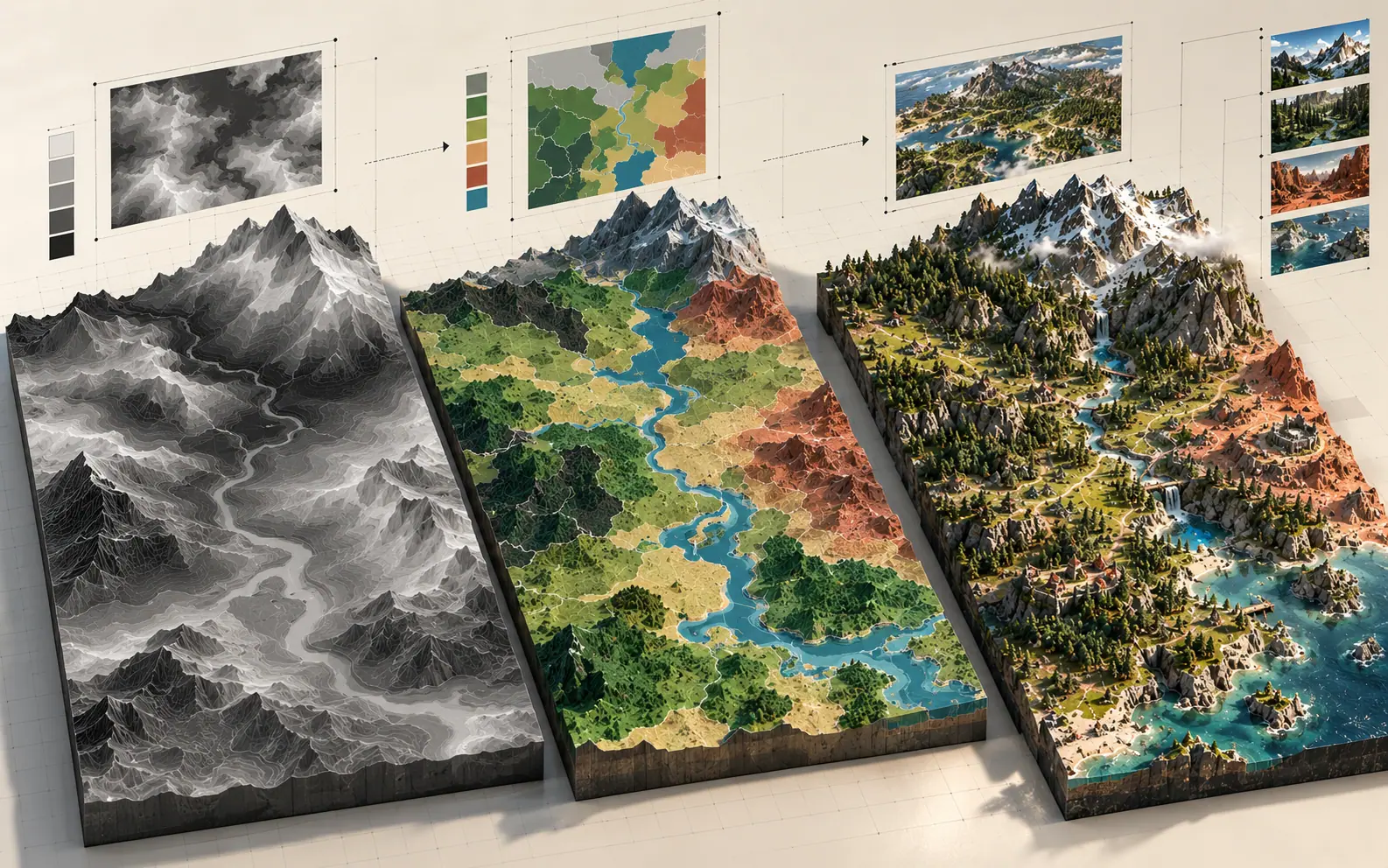
  • Initialize the world using a seed and generation settings.
  • Generate the basic terrain shape and elevation.
  • Assign biomes or environmental regions.
  • Place structures, vegetation, and other features according to rules.
  • Check that the resulting terrain fits the game's requirements and can be explored.
03

Seeds, Rules, and the Balance Between Random and Designed

Randomness creates variation, but rules keep a generated world understandable and playable.

A world seed is often described as the code that makes a world unique, but the seed is only part of the recipe. The generator's algorithms, settings, asset library, and game version also influence the result. Change those ingredients and the same seed may no longer produce an identical world.

Designers rarely want everything to be random. A forest can vary in shape and tree placement while respecting rules about terrain steepness, density, and nearby water. A village might be selected from modular pieces, but its roads need to connect and buildings need to fit the ground. A treasure may be randomly placed within a dungeon, but it should not appear behind an unreachable wall.

These rules act as guardrails. They narrow the range of possible outcomes so the system creates variety without breaking the experience. Designers may also use authored landmarks or hand-built regions to ensure important story beats happen in the right place. A world can be a hybrid: some parts are hand-designed, some assembled from templates, and others generated from mathematical or learned systems.

The interesting design question is not how to make everything random. It is which details benefit from variation and which need deliberate control. Terrain can tolerate many possible shapes, while a carefully timed story encounter may require precise placement. The best systems know the difference.

Hand-designed content

Designers directly shape important locations, encounters, and story moments when precise control is needed.

Rule-based generation

Algorithms combine rules, parameters, templates, and variation to create many possible results.

Hybrid world design

Hand-authored landmarks and generated content work together, balancing control with variety.

04

Generating Dungeons, Buildings, and Level Layouts

Procedural systems can assemble spaces from reusable parts, but successful levels need more than valid connections.

A dungeon generator might begin with a graph of rooms: a starting area, branches, a key room, a reward, and an exit. The system can choose room templates and connect them through doors or corridors. Other rules can determine where enemies, traps, resources, and checkpoints appear.

Modular generation is useful because designers create a library of rooms and define how those pieces may connect. The system can produce different layouts from the same assets. It can also enforce requirements such as ensuring that a key appears before the locked door it opens, or that the player can reach the exit without crossing an impossible gap.

But a layout can be technically valid and still be boring. If every route has the same length, every room the same shape, or rewards appear in predictable places, players may notice the formula. Good level design considers pacing, visibility, risk, surprise, navigation, and the way one space prepares the player for the next.

Procedural generation often works best with constraints and human-authored ingredients. A designer can define a dramatic room, landmark, or boss arena, then let the system create variation around it. The result can feel different across runs while preserving the encounter's intended purpose.

Complex worlds also need to account for movement. A cliff can look impressive but block every useful route. A building can appear correctly on the map yet have no meaningful entrance. Playability requires spatial checks, pathfinding, collision validation, and often actual test runs—not just an attractive layout.
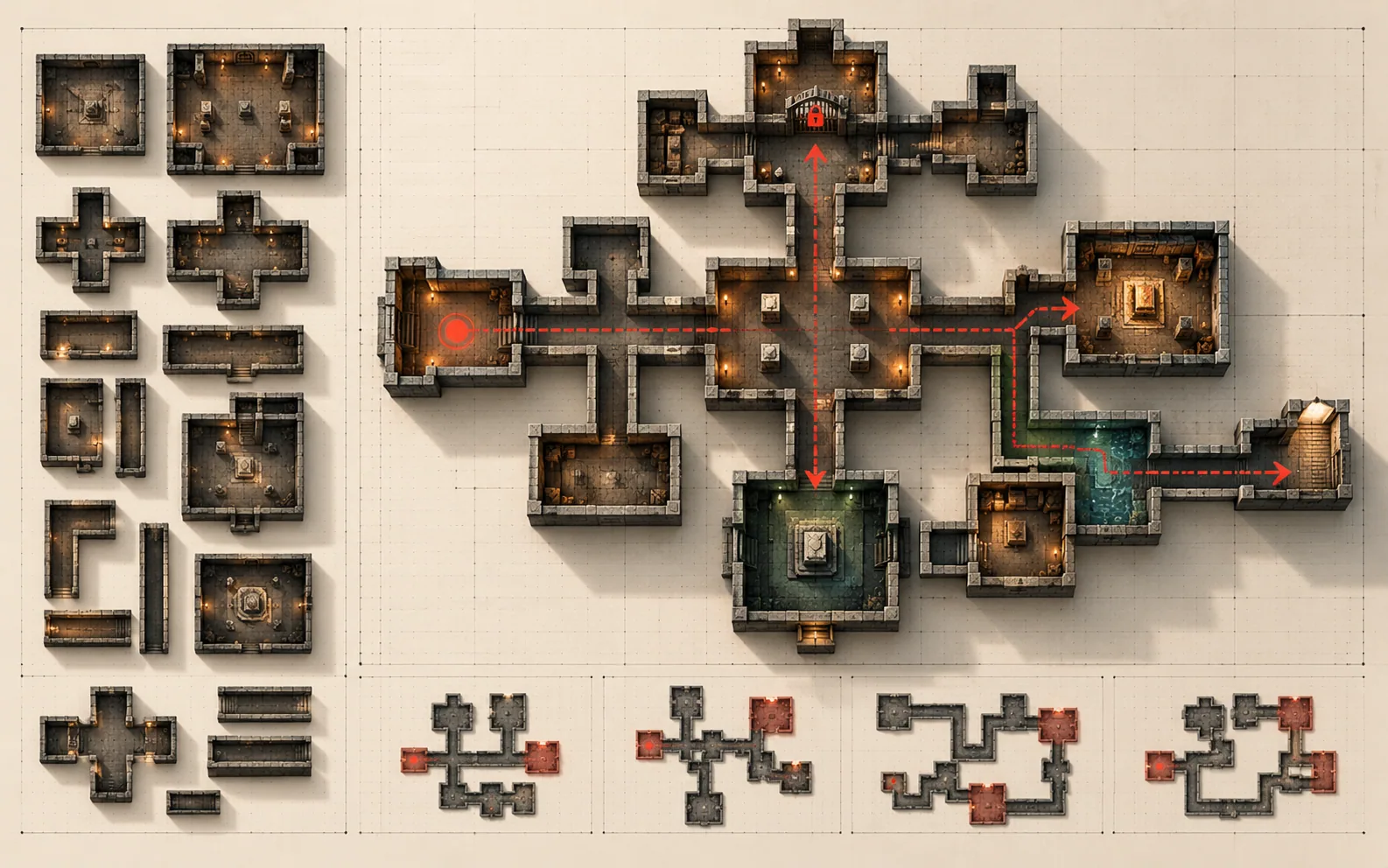
STAGE 1

Define the layout

Set the starting room, possible branches, important objectives, and exit requirements.

STAGE 2

Connect reusable rooms

Select room modules and connect them while respecting rules for doors, corridors, and access.

STAGE 3

Place gameplay elements

Add enemies, traps, resources, checkpoints, and rewards according to design requirements.

STAGE 4

Validate the result

Check accessibility, connectivity, collision, and whether the player can reach required objectives.

05

Quests, Stories, and Worlds That React to the Player

Generating a mission or story is harder than generating a landscape because the result must make sense over time.

A terrain generator mostly works with spatial relationships: height, distance, climate, and placement. A quest adds dependencies. A character might ask for an item, the player may choose to help or refuse, and later events should reflect that choice. If the system invents objectives without tracking prerequisites, it can produce contradictions or impossible missions.

Traditional systems handle this through quest templates, condition checks, authored dialogue, and state machines. A quest template might define the goal, valid locations, required items, and possible outcomes. The generator can choose among approved options while game logic ensures the mission can be completed. This is procedural variation rather than unrestricted AI storytelling.

Generative language models offer another possibility: drafting dialogue, descriptions, rumours, or mission ideas based on context. Yet fluent text is not the same as coherent game logic. A generated character might mention an event that never happened, promise a reward the inventory system cannot deliver, or repeat information the player already knows. Games need memory, constraints, validation, and clear limits on what generated characters can change.

A practical design may combine authored story milestones with generated side content. The main narrative stays stable, while smaller tasks or conversations vary within carefully defined boundaries. That can make a world feel less repetitive without handing the entire story to an unpredictable generator.

The goal is not to make every line and mission unique. It is to make variation meaningful while preserving continuity, fairness, and the player's understanding of what to do next.

“

A quest is not coherent just because its dialogue sounds convincing. Its objectives, conditions, rewards, and consequences must work together.

“Design principle”
06

Traditional Procedural Generation vs. Generative AI

These approaches can both create content, but they work differently and solve different problems.

Traditional procedural generation follows designed algorithms and rules. Developers specify how terrain is shaped, how rooms connect, which objects can appear in a biome, or how an encounter is assembled. The system can be highly varied while remaining predictable enough to test. Its output is constrained by parameters and the assets or templates supplied by the team.

Generative AI uses models trained on data to produce new outputs based on learned patterns and prompts or other inputs. Depending on the system, that output might be dialogue, concept art, textures, level-layout suggestions, or other content. In game production, a model may help artists explore ideas or researchers experiment with dynamic content. It does not automatically understand all the technical and design constraints of a finished game.

The approaches can be combined. A model might propose a room theme or quest description, while a conventional system validates its structure and places it within a known level graph. A generator might create a terrain layout, while deterministic rules enforce safe slopes, playable routes, and resource balance. This hybrid approach uses generative flexibility alongside rules that make the result usable.

Academic surveys review PCG families including search-based methods, machine-learning approaches, noise functions, and emerging large-language-model integration. These surveys describe a research field, not proof that every commercial game uses generative AI to build its world. Procedural generation is an established design approach; many newer generative-AI uses remain experimental or apply to specific parts of a production workflow.

ApproachHow it worksStrengths and limits
Traditional procedural generationDesigned algorithms, rules, seeds, templates, and noise functionsPredictable constraints and repeatable variation.
Generative AIModels learn patterns from data and generate outputs from inputsFlexible proposals or content, but output may need validation.
Hybrid pipelineAI proposes or varies content while rules and tests enforce constraintsCombines flexibility with stronger control, but adds integration complexity.
07

Why Generated Worlds Can Feel Empty or Repetitive

A world can be enormous and still feel lifeless if its content lacks purpose, variation, or meaningful relationships.

Size is easy to measure; meaningful discovery is not. A generator can create huge terrain, but players may stop exploring if landmarks look alike, rewards repeat, or travel rarely changes their decisions. More content does not necessarily mean more interesting content.

Repetition can emerge when the system draws from a small asset library or uses the same rules in every region. A forest may contain different tree positions but still offer the same sightlines, enemies, and activities. A generated quest may change names and locations while asking the player to perform the same task. The surface details vary, but the underlying experience does not.

Coherence matters just as much. A settlement needs a reason to be where it is. Paths should lead somewhere useful. Environmental storytelling works when objects, architecture, and landmarks suggest a history or purpose. Even a surreal world benefits from consistent internal rules, because players learn those rules and use them to make predictions.

Designers can improve results by varying not only appearance but also function. Regions can introduce different movement challenges, resources, threats, or choices. Landmark placement can help players navigate. Hand-authored events can punctuate generated stretches with memorable moments. Human playtesting can reveal whether exploration feels rewarding or merely long.

There is also a performance cost. A system that creates content as the player moves must manage memory, loading, streaming, and frame time. If the world stutters while generating a new area, its scale becomes a technical burden instead of a benefit. A successful generator balances variety, coherence, pacing, and performance.

A bigger world is not automatically a better world

Players remember meaningful discoveries, useful choices, and coherent places—not simply the number of kilometres or rooms a generator can produce.

09

The Limits, Risks, and Future of AI-Generated Worlds

AI and procedural tools can expand the range of possible content, but developers still need to curate, validate, and test what they produce.

Generated content creates practical questions. Does the environment remain playable? Does it fit the game's visual identity? Is the story consistent? Can the result run on the intended hardware? Does it create inaccessible routes, unfair encounters, or repetitive tasks? Each question needs its own checks, and no single model can answer them all reliably.

Generative models also depend on data, training, and evaluation. Output quality can vary, and a model may struggle when a game requires a very specific style, a small amount of training material, or strict logical consistency. Teams must consider how data and tools are sourced, whether generated assets meet project rights and licensing requirements, and how human creators review results. These are production concerns as much as technical ones.

A realistic future is likely to involve more hybrid pipelines. Procedural systems can build reliable structures and terrain; generative models may help propose variations, dialogue, textures, or design ideas; automated tests can check constraints; and human designers can select, edit, and polish the final result. In some games, content might adapt to player choices, but that adaptation will need limits so the world remains understandable and fair.

For players, the best outcome is not an infinite map filled with disposable material. It is a world with more surprising discoveries, useful variation, and places that feel connected. For developers, the best outcome is not removing design work, but spending less time repeating predictable tasks and more time shaping the experience.

AI can help generate worlds. It cannot, by itself, decide what makes a world worth remembering. That remains a question of design, craft, and the people who play the game.
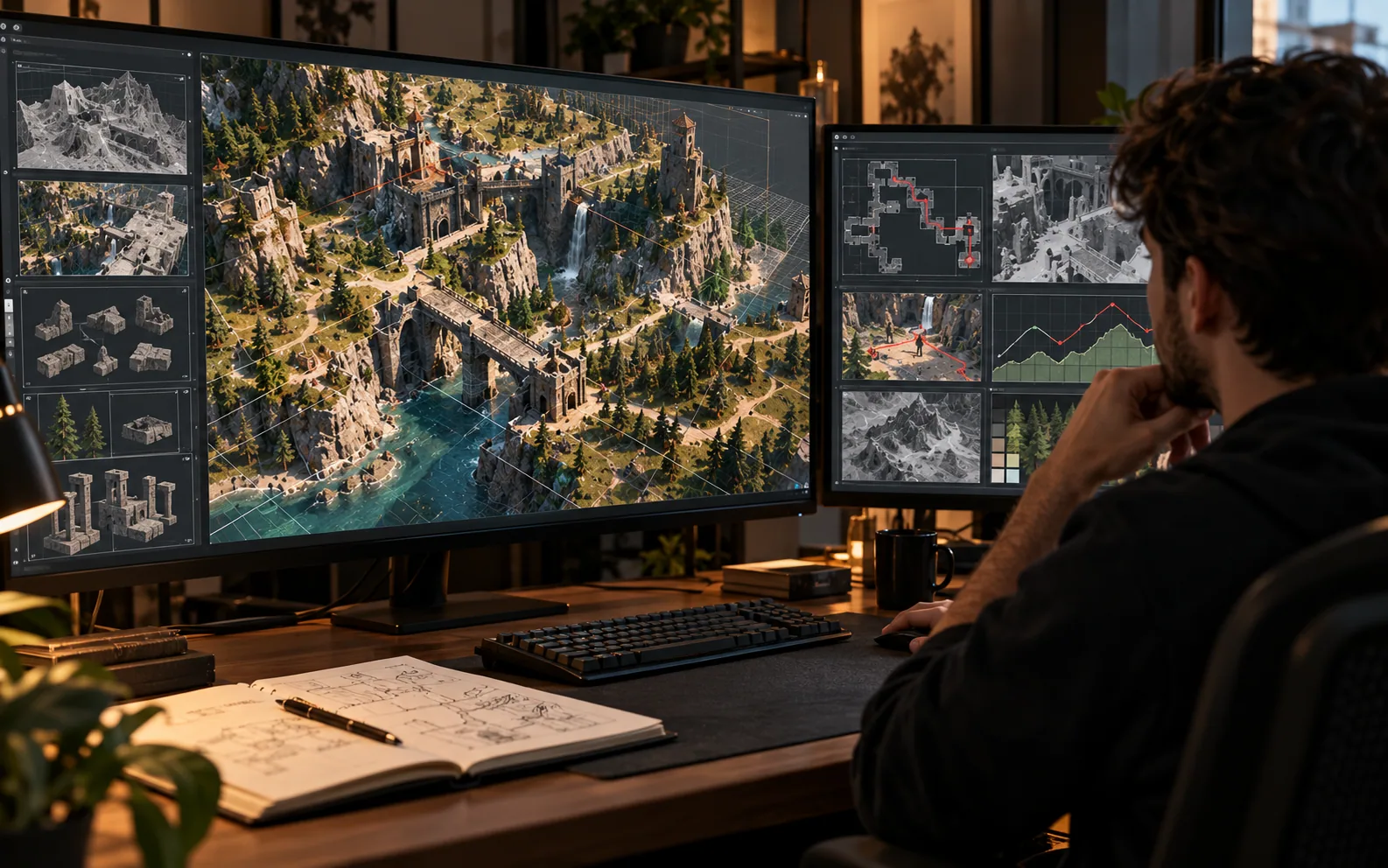
The real achievement is not generating endless content. It is creating a world where variation serves exploration, design, and the player.

09 — FAQ

Frequently asked questions about How AI Can Generate Worlds in Video Games

What is AI-generated world creation in video games?

It means using AI techniques to help create parts of a game world, such as terrain, objects, layouts, or story content. Many worlds are generated through traditional procedural algorithms rather than AI models.

What is procedural generation in games?

Procedural generation uses algorithms and rules to create game content automatically, including terrain, biomes, structures, rooms, items, and other elements.

Is procedural generation the same as generative AI?

No. Procedural generation is a broad technique based on algorithms and rules. Generative AI uses models trained on data to produce new outputs. A game can use either or combine them.

How does Minecraft generate its worlds?

Minecraft uses procedural world generation in multiple stages. Official creator documentation describes passes for terrain, biomes, structures, features, and other setup steps.

Can AI generate an entire open-world game?

Generating a complete polished world is harder than generating individual assets or terrain. A game also needs coherent objectives, progression, performance, testing, art direction, and playable rules.

Can AI create quests and stories in games?

AI models can help draft or vary quest text and story content, but systems need constraints and validation to maintain continuity, feasible objectives, and consistent game state.

Why do procedurally generated worlds sometimes feel repetitive?

Generators may reuse a limited set of assets, patterns, or task structures. Variation in appearance alone does not guarantee meaningful choices, distinct activities, or memorable exploration.

Will AI replace game world designers?

AI can assist with variation and early content creation, but human designers remain important for art direction, pacing, playability, coherence, and deciding which generated results are worth keeping.

Junaid
About the author

Junaid

Founder & Editor-in-Chief at Barlin Games

Founder and Editor-in-Chief of Barlin Games, covering games, studios, developers, gaming culture, and the stories behind the industry.

21 Articles Published
Love this article? Building a better way to discover games. View all articles