
How Does Enemy AI Work in Video Games?
Ever wondered how enemies spot you, follow your movements, search for hiding players, and decide when to attack? Discover how enemy AI uses perception, decision-making, navigation, combat logic, and carefully designed behaviour to create challenging encounters in video games.
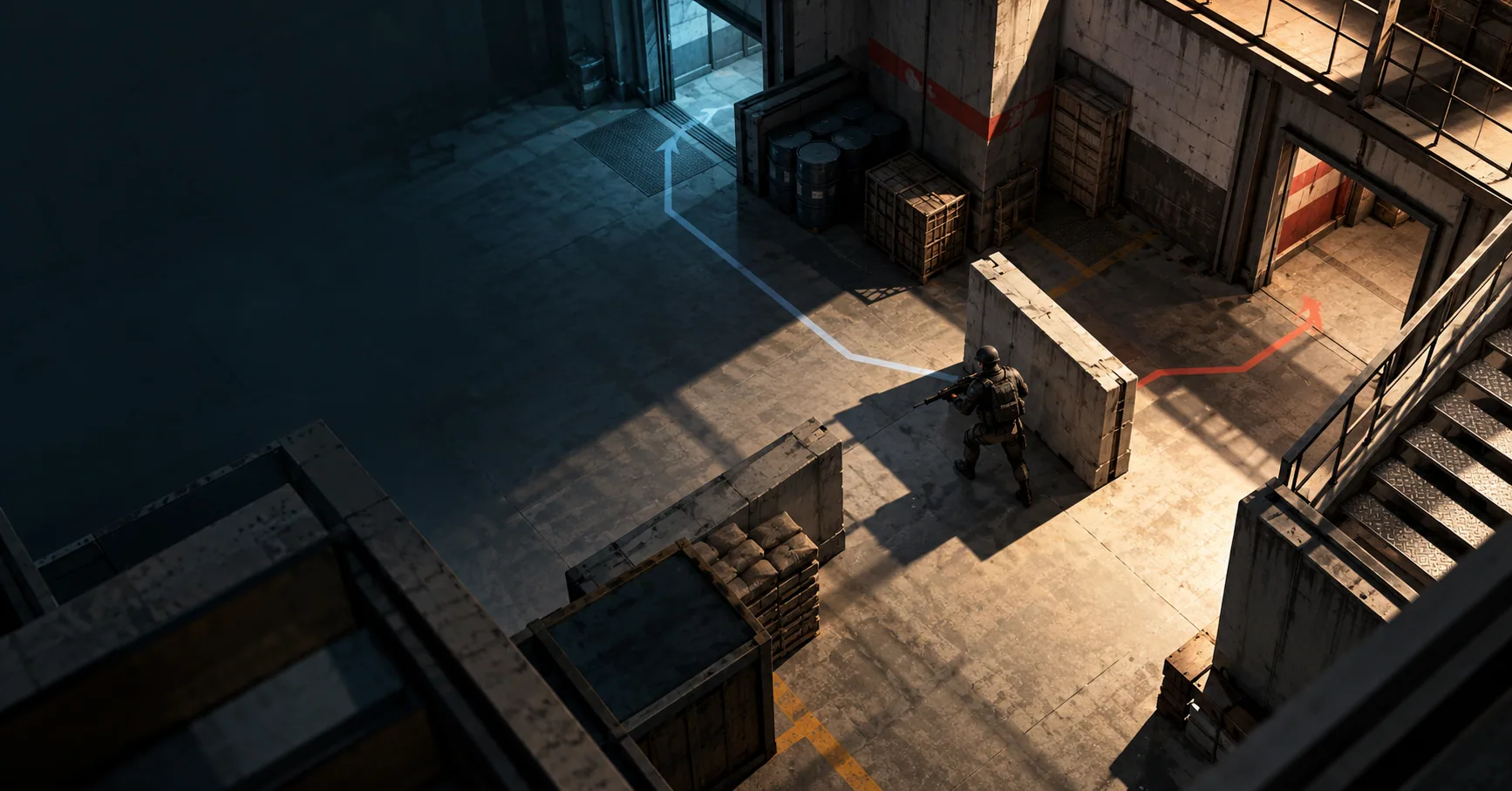
On This Page Explore this article
In many games, enemy awareness begins with a perception system. The system checks whether relevant events have occurred and passes that information to the logic controlling the character.
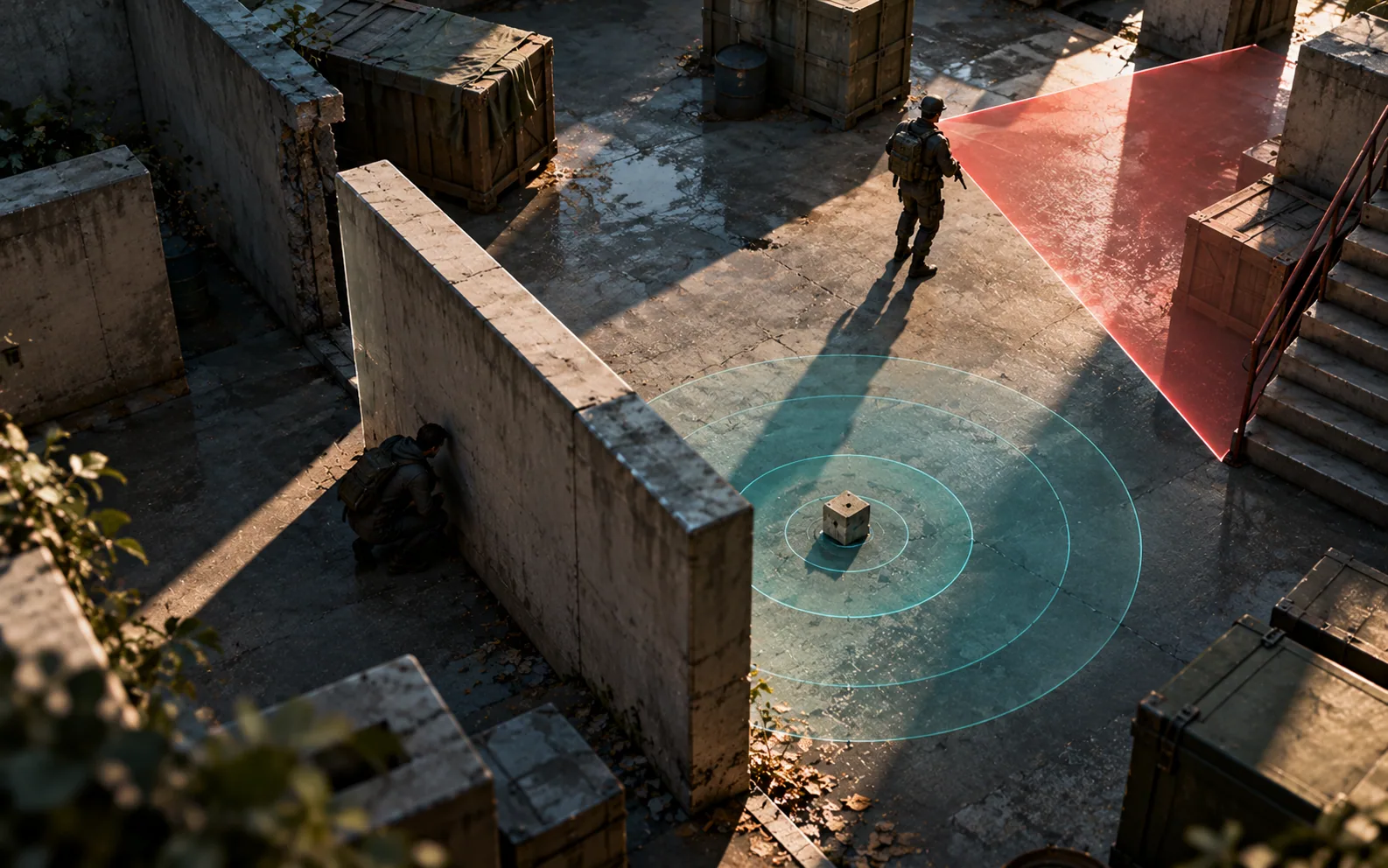
Sight may depend on distance, viewing angle, line of sight, or other game-specific conditions. An enemy might detect the player in an open corridor but fail to see them behind a wall. Some games add lighting, disguise, camouflage, or movement speed to make visibility more complicated.
Sound creates another layer. Running across a noisy surface, firing a weapon, opening a door, or throwing an object may produce an event that attracts nearby enemies. The AI might receive the sound's location without immediately knowing who caused it. That distinction lets an enemy investigate an area rather than magically knowing the player's exact position.
Enemies may also react to damage, nearby combat, a missing patrol partner, or an alarm. Developers decide which events matter and how much information each event provides. One enemy might become suspicious after hearing a noise, while another immediately enters combat after seeing the player.
These rules define the limits of enemy knowledge. If an enemy can track the player through every wall or knows their location long after losing sight of them, stealth can feel unfair. Carefully designed perception allows enemies to be threatening without making the game feel as if the rules are secretly working against the player.
- Sight: Detects visible targets within configured conditions.
- Sound: Responds to noises and investigates their likely source.
- Damage: Reacts when hit or alerted by nearby combat.
- Events: Responds to alarms, missing allies, or scripted gameplay triggers.
- Memory: Retains information such as a last-known player location for a limited or designed period.
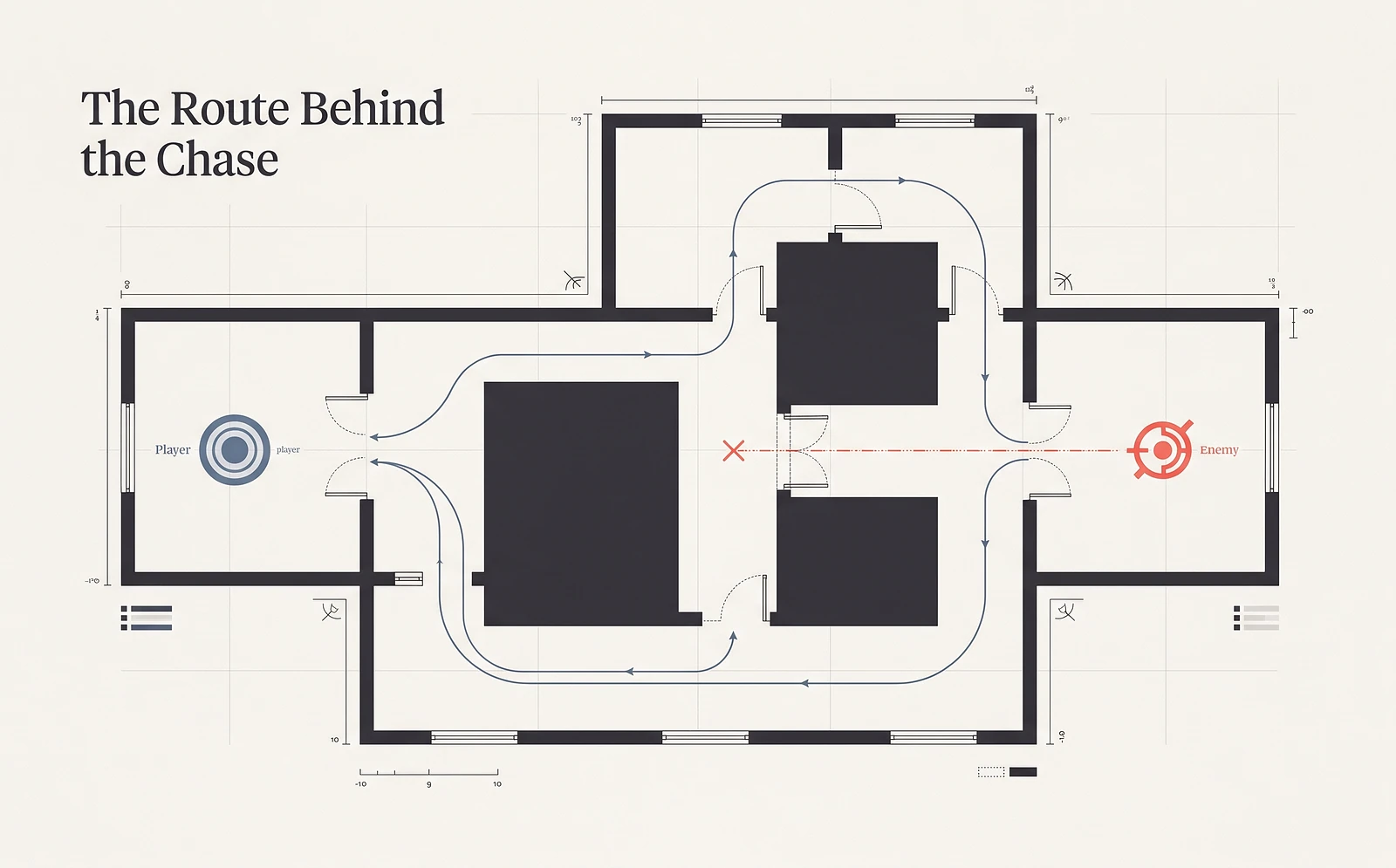
A game world may contain corridors, rooms, walls, stairs, obstacles, and narrow passages. The enemy needs a route that makes sense for its size, movement abilities, and current objective.
Many games use a navigation mesh, often called a NavMesh, to represent areas where a character can move. Pathfinding algorithms can then calculate a route from the enemy's current position toward a destination. The character's movement controller follows that route, adjusting to turns and obstacles along the way.
Pathfinding and behaviour are related but different. Pathfinding helps answer, "How can I get there?" Decision logic answers, "Where should I go, and why?" An enemy may calculate a valid path to the player's last known position but still need to decide whether chasing is appropriate.
Developers also need to handle situations in which a route becomes blocked, a target moves, or the character cannot reach its destination. Depending on the game, the enemy may recalculate its path, choose another route, wait, or switch to a different behaviour.
Navigation can also contribute to personality. A heavy enemy might move directly toward the player, while a more tactical opponent seeks a flank or a designated position. These differences come from movement capabilities and decision rules working together, not from pathfinding alone.
Inside the story
One image from this article

Frequently Asked Questions About Enemy AI in Video Games
Enemy AI determines how hostile characters perceive players, make decisions, navigate environments, and respond during gameplay. These frequently asked questions explain the main systems behind the enemies players encounter.
What is enemy AI in video games?
Enemy AI is the collection of systems that controls hostile characters' perception, decisions, movement, and actions. It determines how enemies detect players, choose targets, pursue objectives, attack, and react to changing situations.
How do enemies detect players in games?
Enemies may use sight, sound, damage events, and other gameplay triggers. Developers configure the conditions that activate each response, such as detection range, viewing angle, line of sight, or the location of a noise.
What is a behavior tree in game AI?
A behavior tree organizes an AI character's decisions and actions into a structured hierarchy of tasks and conditions. It can help determine when an enemy should patrol, investigate a sound, chase a player, or perform another action.
How do enemies find their way around game levels?
Many games use navigation data and pathfinding to calculate routes through walkable areas. The enemy's decision system selects a destination, while navigation helps it find a route around obstacles and toward that goal.
Do enemies in video games actually learn from players?
Some games use systems that adapt or respond to player behaviour, but many enemies follow authored rules and predefined decision logic. A character reacting differently to a situation does not necessarily mean it is learning through machine learning.
Why do some enemies seem to know where the player is hiding?
The enemy may have detected a sound, retained the player's last known location, received information from another character, or been given scripted knowledge. If it tracks a hidden player without a valid in-game cue, the behaviour may also reflect a design choice or a bug.
Why do enemies sometimes get stuck or behave strangely?
Navigation problems, blocked routes, conflicting conditions, poor tuning, or incorrect state transitions can cause unexpected behaviour. Developers use debugging tools and repeated tests to find and fix these problems.
Does harder enemy AI always mean smarter enemies?
No. Difficulty can be increased through factors such as damage, health, accuracy, reaction time, or more aggressive rules. More convincing AI depends on how well an enemy perceives, decides, and acts within the game's intended rules—not simply how hard it is to defeat.

Junaid
Founder & Editor-in-Chief at Barlin Games
Founder and Editor-in-Chief of Barlin Games, covering games, studios, developers, gaming culture, and the stories behind the industry.